I was flattered to be a guest on JG Michael’s Parallax Views to discuss the Paramount-WBD merger, the financing behind it, and the legal settlement that let it proceed. Give it a listen!
Wall Street seems to be noticing that the data center boom is being financed based on wildly optimistic revenue projections as unfinished projects and unused chips pile up.
Meanwhile, the “philosophical” claims of AI boosters (“AI Agents are intelligent and deserve equal rights”) are getting more extreme, even as their credibility takes hit after hit.
Let’s start with Oracle out in the desert.
Oracle Plays Rare ‘Force Majeure’ Card
These rich kids and their card games; some of them have cards in their deck no one else has. Oracle CEO Larry Ellison is no exception, pulling out a very rare “force majeure” card to protect itself should one of its “Stargate” data centers in New Mexico not come online as scheduled. Per Bloomberg (archived):
Oracle Corp. is moving to shield itself from racking up expenses on a massive data center being built in New Mexico, adding a fresh wrinkle to a project beset by opposition and regulatory setbacks.
The technology giant sent the project’s developer, a unit of Blue Owl Capital Inc., a notice citing force majeure, according to people familiar with the situation. Rather than trying to walk away as the site’s main tenant, Oracle is attempting to put off payments should the data center dubbed Project Jupiter get derailed and fail to come online in 2028 as planned, the people said, asking not to be identified discussing private matters.
“The people said,” that’s some remarkable anonymous sourcing right there. Were these people the reporter met behind a 7/11 in Truth or Consequences, New Mexico, or what?
But that’s neither here nor there. After hearing from both Oracle and Blue Owl spokesweasels that force majeure is totally common, everyday stuff, the piece gets down to brass tacks about what this means for the project announced with such fanfare by Donald Trump, Larry Ellison, Masayoshi Son of SoftBank, and OpenAI’s Sam Altman in early 2025:
If the two sides agree that a force majeure event tied to meeting power commitments has occurred, then Oracle could win a three-year delay on rent when those payments commence, one of the people said. The company would still have to pay other costs in the interim and owe the rent for the full lease term once payments begin, the person said.
…
Almost two years later, the campus designed to handle 2.45 gigawatts — enough electricity to power roughly 1.8 million homes at any given moment — has hit serious setbacks including the denial of a permit key to its plans for energy resources.
…
A group of about 20 banks provided an $18 billion loan to help fund the construction of the data center campus, one of several mega-debt deals that have helped bankroll the AI infrastructure boom.
Bloomberg also does some contortions to make “force majeure” seem like a totally normal, everyday business move:
Force majeure provisions are relatively common in the energy and commodities world when events such as bad weather and geopolitical conflicts disrupt supplies, leaving companies unable to fulfill their contracts. The clauses are becoming more common in data center developments as well, according to a recent client alert from Quinn Emanuel Urquhart & Sullivan LLP.
“In AI data center projects, force majeure is no longer a back-end boilerplate provision,” the June alert said. “It is a core litigation and risk-allocation tool that can determine whether a delay remains isolated — or cascades through the project’s construction, customer, power, insurance, and financing documents.”
Big Short investor folk hero Steve Eisman points out that ‘force majeure’ is an “Enron-era trick” and it doesn’t take much Googling to confirm that the “smartest guys in the room” had the force majeure card in their deck and weren’t afraid to employ it.
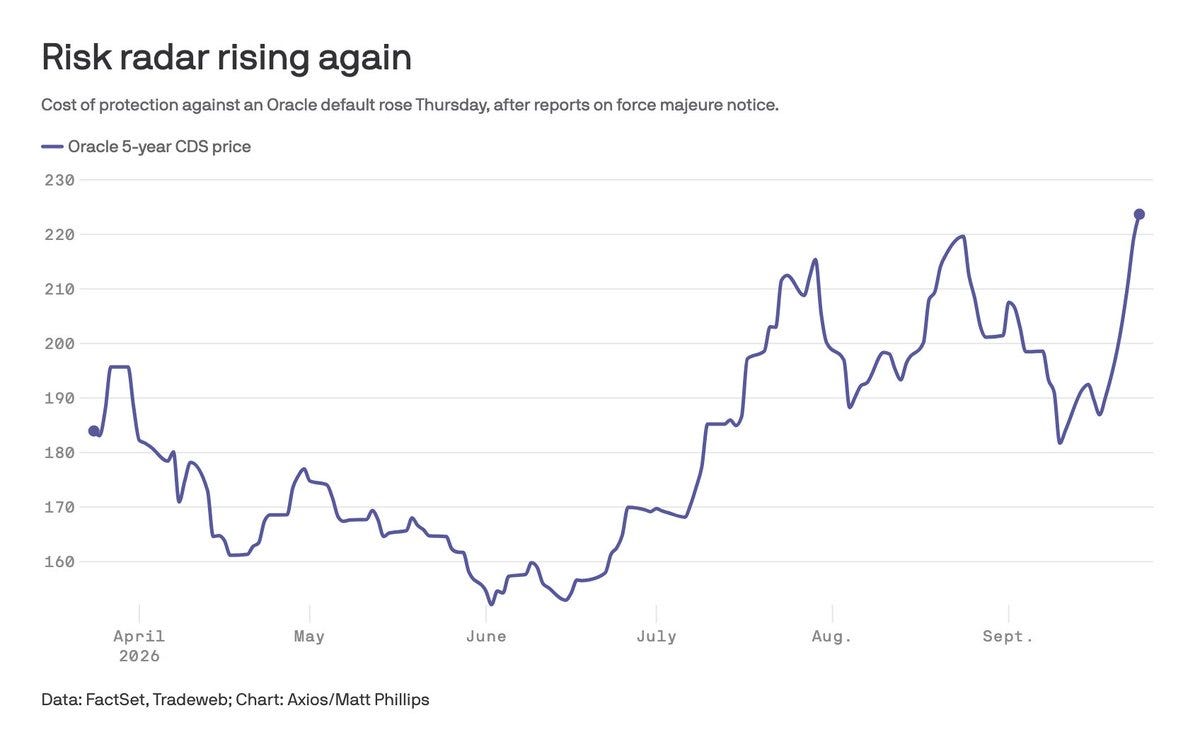
Axios pointed out that this kind of thing had an immediate impact on the cost investors seeking to protect themselves from an Oracle default have to pay: