

Following the U.S. seizure of an Iranian ship, Iran has announced they will not be sending a delegation to Islamabad for another meeting with American Vice-President J.D. Vance, Jared Kushner, and Steve Witkoff.
Tehran is not currently planning to take part in new talks with the US, Iran state media reported on Sunday evening, as its military accused America of violating a fragile ceasefire between the two countries, hours after Donald Trump said he was dispatching negotiators to Islamabad.
President Donald Trump announced on Sunday that an Iranian cargo ship that tried to get past the US-enforced blockade near the strait of Hormuz had been seized. “We have full custody of their ship, and are seeing what’s on board!” Trump wrote on social media.
Iran’s military said the ship had been travelling from China. “We warn that the armed forces of the Islamic Republic of Iran will soon respond and retaliate against this armed piracy by the US military,” state media quotes an Iranian military spokesperson as saying.
Via the Wall Street Journal, more leaks from inside the White House confirm the picture of a mad king, raging impotently and excluded from key briefings (archive):
It was Good Friday afternoon in a nearly empty West Wing soon after the president learned that an American jet had been shot down in Iran, with two airmen missing. Trump screamed at aides for hours. The Europeans aren’t helping, he said repeatedly. Gas prices averaged $4.09. Images of the 1979 Iranian hostage crisis—one of the biggest international policy failures of a presidency in recent times—had been looming large in his mind, people who have spoken to him said.
“If you look at what happened with Jimmy Carter…with the helicopters and the hostages, it cost them the election,” Trump had said in March. “What a mess.”
Trump demanded that the military go get them immediately. But the U.S. hadn’t been on the ground in Iran since the government overthrow that led to the hostage crisis, and they needed to figure out how to get into treacherous Iranian terrain and avoid Tehran’s own military. Aides kept the president out of the room as they got minute-by-minute updates because they believed his impatience wouldn’t be helpful, instead updating him at meaningful moments, a senior administration official said.
Is that you, Susie Wiles?
But wait, there’s more:
He is veering between belligerent and conciliatory approaches and grappling behind the scenes with just how badly things could go wrong.
At the same time, the president sometimes loses focus, spending time on the details of his plans for the White House ballroom or on midterm fundraisers—and telling advisers he wants to shift to other topics.Trump has resisted sending American soldiers to take Kharg Island, for example, the launch point for 90% of Iran’s oil exports. While he was told the mission would succeed, and the territory’s capture would give the U.S. access to the strait, he worried there would be unacceptably high American casualties, the people said. They’ll be sitting ducks, the president said.
Still, he has made risky pronouncements without input from his national security team—including his post about plans to destroy the Iranian civilization—saying seeming unstable could help spur the Iranians to negotiate.
At one point he even mused he should award himself the nation’s highest military honor, the Medal of Honor.
Amazing how accurate Trump’s King Lear act is for a guy who claims he doesn’t read Shakespeare.
Although I can’t remember any Shakespearean tragedy that featured over $1 Billion in insider trading:
On 23 March, traders placed $580m in bets on the oil futures market just 15 minutes before Trump said on social media that the US was having “productive” talks with Iran, according to the Financial Times. The traders made a windfall after Trump’s comments triggered a sell-off in the oil markets that made oil prices plummet.
The same thing happened again on 7 April, this time when traders spent $950m on oil futures, betting that the price of oil would fall just hours before the ceasefire with Iran was announced.
But Mr. Market isn’t just dirty, he might be delusional as well.
This latest newsletter from Michael W. Green, described by Institutional Investor as having “some serious Street cred — he worked for Canyon Capital and tech billionaire Peter Thiel, and founded a fund seeded by George Soros” is pretty big evidence of cray cray:
“Iran” no longer exists as a unified political voice. The IRGC, the National Security Council, and the diplomatic class are arguing publicly:
“Following the unexpected tweet from the Foreign Minister about the liberation of the Strait of Hormuz, Iranian society has been plunged into an atmosphere of confusion.”
…Now some in the media are, of course, seizing on the confusion to highlight that Trump is once again deeply out to a Taco Bell salad lunch. And I want to emphasize that there can be two truths — Trump can be deeply disturbed AND Iran’s leadership has fractured as the US prevails in the conflict. We have precedent. After victories in Italy, Germany, AND Japan in WW2, internal conflict prevented consolidated messaging. After Hitler’s suicide and contested elevation of Karl Dönitz, pockets of German and Czech military refused to accept the surrender.
The US Navy is fully in control of the Hormuz. Those carriers hanging outside missile range are no longer threatened.
His evidence for the above is a screen shot of what appears to be ChatGPT or Gemini output that helpfully cites The Atlantic Council as its source for claims that “As of April 2026, the US Navy maintains a major force in the Strait of Hormuz and the Persian Gulf — led by the USS Abraham Lincoln and USS Gerald Ford carrier strike groups.”


Don’t tell him that according to the US Naval Institute, the Gerald Ford is in the Red Sea and the Lincoln’s last reported whereabouts were in the Arabian Sea a few thousand kilometers away from the Strait, much less the Persian Gulf.


But wait he’s got more, this time about oil supplies:
The oil story collapsed under its own weight on Friday. Sure, Trump was the catalyst. But the reality that many are recognizing now has been well publicized on these pages — much of the oil was already making it out and demand destruction, particularly in emerging markets has been significant…
By my calculations, roughly 2MMbd in demand has already been destroyed. Had prices maintained at these levels, within six months we were looking at 10-20MMbd. Some of that lost demand will return as prices fall and we restock strategic reserves, but some will be permanently lost. We don’t run HVAC twice as much after skipping for a day, nor do we make two trips to the store to make up for the one we skipped last week. Combined with modestly increased production and (as predicted) removal of restrictions on Russian exports, oil will be increasingly well supplied. Meanwhile, the disruption is likely to prove unhelpful to a fuel likely already at peak demand.
So yea, wow.
He’s even more confident than the U.S. Secretary of Energy:
Chris Wright, the Trump administration’s energy secretary, acknowledged Sunday that it might not be until 2027 before US gas prices come back under $3 a gallon.
Asked by Jake Tapper, the CNN State of the Union host, when he thought “it’s realistic for Americans to expect the gas will go back to under $3 a gallon”, Wright replied: “I don’t know. That could happen later this year. That might not happen until next year.”
Wright then maintained, without elaborating that “prices have likely peaked and they will start going down”. He said a conclusion to the war in Iran that the US started alongside Israel in late February would see energy prices “go down”.
‘What, me worry?’ may be the au courant catchphrase on Wall Street and D.C. but those worrywarts at the United Arab Emirates just haven’t gotten the memo, per the WSJ:
The United Arab Emirates has opened talks with the U.S. about obtaining a financial backstop in case the Iran war plunges the oil-rich Persian Gulf state into a deeper crisis, U.S. officials said.
U.A.E. Central Bank Governor Khaled Mohamed Balama raised the idea of a currency-swap line with Treasury Secretary Scott Bessent and Treasury and Federal Reserve officials in meetings in Washington last week, the officials said. The Emiratis emphasized that they had so far avoided the worst economic effects of the conflict but might still need a financial lifeline…
In talks with the U.S. in recent days, they have portrayed the proposal as preliminary and precautionary, the U.S. officials said.
But they have also argued that it was President Trump’s decision to attack Iran that entangled their country in a destructive conflict whose effects may not be over, some of the officials said. Emirati officials told the U.S. officials that if the U.A.E runs short of dollars, it may be forced to use Chinese yuan or other countries’ currencies for oil sales and other transactions, some of the officials said.
Maybe we can take up a collection and gift the Emirates a subscription to Michael W. Green’s Substack to calm their shaky nerves.
Council on Foreign Relations Senior Fellow Brad W. Setser has some thoughts:


Given the central bank’s ample apparent liquidity, the immense assets of Abu Dhabi’s sovereign funds and the UAE/ Abu Dhabi’s clear ability to borrow dollars, I am not sure there is a realistic prospect that the UAE will ever run short of dollars
But the fact that they have asked is interesting — and they clearly think the threat of using yuan is a way to get the attention of the United States (my sense is that the Trump Administration is a bit too concerned about this … )
I rather doubt that the Fed would give the Emirates a swap line — they are keen to limit the use of Fed swaps to G-10 countries with long-standing ties to the Fed … and clearly don’t want to fund geopolitical risks or a shortfall in oil revenues
And the Treasury’s exchange stabilization fund has fewer resources than the UAE’s central bank (at the end of February) and certainly fewer resources than the central bank, ADIA and the other sovereign funds …
But the UAE might still want the symbolic vote of confidence
to my mind though there is a significant substantive issue with any swap line with the UAE — namely the UAE’s horrible balance of payments data and long history of limited transparency about its finances/ the size of its sovereign funds …
And there isn’t anything obviously “America first” about a financial lifeline to one of the richest oil sheikdoms (if not the richest) just so it doesn’t have to borrow in the market/ sell assets …
But very interesting that this request was both made and that it made its way into the WSJ …
Clear that parts of the UAE aren’t happy about being asked to absorb the full financial costs of Trump’s bombing campaign
UAE Poli Sci Professor Abdulkhaleq Abdulla has some thoughts:

The UAE’s recent discussion of changes to its Chinese investment strategies may or may not be related, per Bloomberg:
Abu Dhabi is considering plans to consolidate Chinese assets housed within two of its wealth funds under a new entity, setting the stage for a radical overhaul of its investment strategy for the world’s second-largest economy.
The proposed investment vehicle will be jointly owned by the two wealth funds, L’imad Holding Co. and Mubadala Investment Co., according to people familiar with the matter. This would help avoid multiple Abu Dhabi vehicles competing for the same deals as the emirate looks to boost its exposure to China…
…
L’imad is overseen by Abu Dhabi’s Crown Prince, Sheikh Khaled bin Mohammed, a son of United Arab Emirates President Sheikh Mohammed bin Zayed who has taken on more prominent national security and economic roles over the past year. Mubadala is helmed by Khaldoon Al Mubarak, who has handled key relationships for Abu Dhabi, including China, for years.
Al Mubarak was among executives who accompanied the crown prince to China this week for meetings with President Xi Jinping.L’imad has exposure to China via sovereign investor ADQ, which it absorbed this year, while Mubadala has deployed over $20 billion across more than 100 investments in China since 2015. The two entities have close links — Al Mubarak and his deputy at Mubadala are both part of L’imad’s board.
The UAE isn’t the only Gulf state feeling the heat.
Qatar is looking anew at their strategic situation per the NYT:
Trapped between their chief ally and their neighbor, (the Gulf states) are now forced to rethink their security strategies.
The war has caused a state of “strategic shock” for Qatar and its neighbors, said Rashid Al-Mohanadi, the vice president of the Center for International Policy Research, a think tank in Qatar.
“There was an assumption that such a big move in the region, like starting a war with Iran, would at least happen in consultation with the Gulf,” he said. “We thought we had a better working relationship with the United States.”
…
In recent years, the government sought to cultivate close ties with President Trump, donating a Boeing 747 jetliner to him. A Qatari government-owned real estate firm sealed a deal last year with Mr. Trump’s family business, the Trump Organization, to construct a Trump-branded golf course in Qatar.And when Mr. Trump visited Qatar last May, he signed an agreement with officials there “to generate an economic exchange worth at least $1.2 trillion,” the White House announced.
Despite all of that, Qatar was able to exert little control over a war that directly involved it.
The uncomfortable realization that Israel appears to have more influence over Mr. Trump’s decisions than Gulf leaders do has reverberated through Gulf royal courts, analysts said.
Maybe they are following Trump on Truth Social:
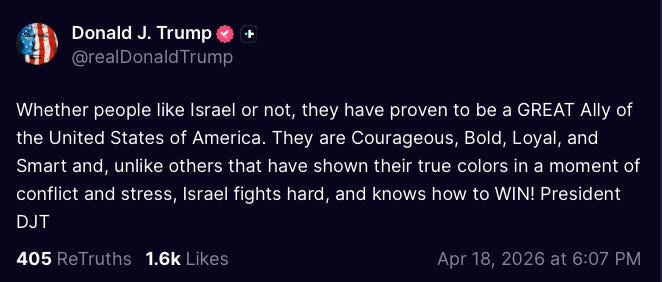
The Times also goes back to the well of lies for this sentence that I simply have to quote: “The war’s human toll in Qatar has been mitigated by air-defense systems that intercepted most attacks.”
Just like all those Russian missiles in Ukraine and every missile ever fired at Israel.
No wonder Mr Market is so deluded.
I’ll close today’s update with some war college talk from the Financial Times:
Hossein Dadvand is a greying commander who runs an important combat college north of Tehran. He is tasked with training the thousands of Iranian soldiers who pass through his barracks gates on how to fight — and win — on the battlefield.
In the lead-up to the weeks-long war with Israel and the US, Dadvand was among those within Iran’s military assiduously mining the war in Ukraine for strategic lessons.
…
His recommendations were published in a prestigious Iranian defence publication two years ago. Iran, he appealed to his superiors, must invest in drones, use nimbler and more mobile combat units, and update how it trains and fights.
…
Iran has closely studied Ukraine for lessons, especially about drones, has been focused on modernising its cyberwarfare assets, and is worried about its forces’ forward planning. They show Tehran has closely watched Russian performance as well as how Ukraine has adapted to fighting a much more powerful opponent.“The Russia-Ukraine war was one of the cases that we examined carefully,” Dadvand said. “One of the most important points in that war was the widespread use of small drones and artificial intelligence. We are witnessing the entry of advanced technologies such as artificial intelligence, quantum, and nano into the military arena.”
Stay safe, y’all.
Originally published at NakedCapitalism on April 20, 2026.