

As the ceasefire POTUS Trump unilaterally declared earlier this week continues, much of the discussion of the Iran War centered on whether the US or Iran is better positioned to outlast their opponent.
Bluster From the Oval Office
Trump opened the day Wednesday talking trash on Truth Social about ordering the US Navy to “shoot and kill any boat, small boats though they may be…that is putting mines in the waters of the Strait of Hormuz. …Additionally, our mine “sweepers” are clearing the Strait right now.”
As I covered yesterday, even CBS News is reporting that “roughly 60% of (Iran’s) naval arm” is still extant.
I should also mention that the US decommissioned most of its minesweepers in the region last year and the task is now delegated to the Littoral Combat Ship (aka “The Little Crappy Ship”) which is largely unsuitable for the task.
Oh, and yea, the US Navy has zero presence in the Strait of Hormuz and hasn’t since a pair of destroyers ventured there on the 11th and quickly skedaddled under threat of Iranian fire.
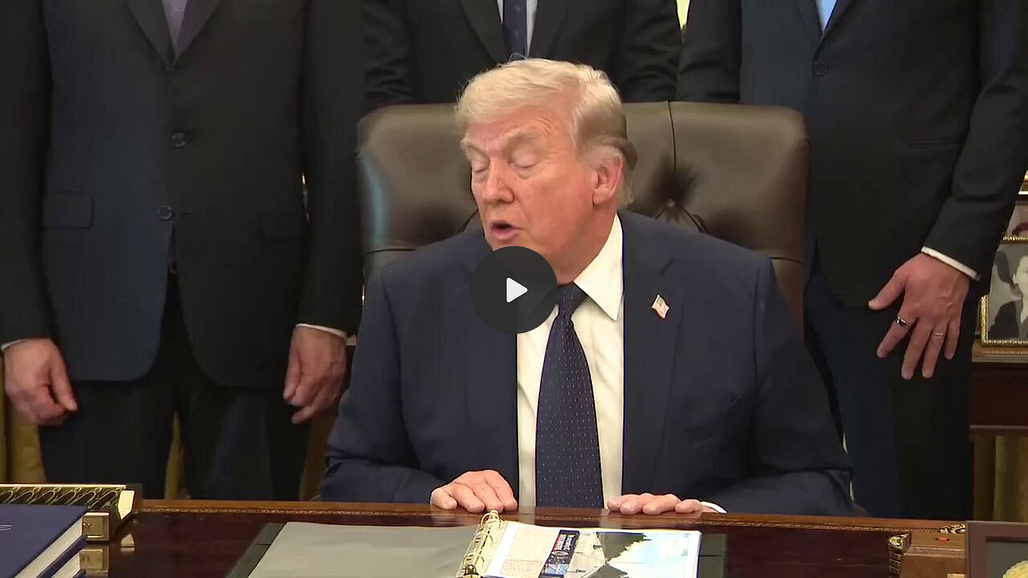
At a press event, Trump admitted the Iranians were prepared to open the Strait, until he imposed his counter-blockade:

CNBC reports on activity in the Strait on Thursday:
U.S. forces on Thursday intercepted a sanctioned tanker in the Indian Ocean that was carrying oil from Iran, the Pentagon said in a social media post. The U.S. recently blocked the Iranian tankers M/V Hero II, M/V Hedy and M/V Dorena, U.S. Central Command said Wednesday.
Iran, meanwhile, claimed Wednesday to have seized two cargo ships that attempted to transit the Strait of Hormuz “without authorization,” according to the state news agency Tasnim.
Trump also posted about extending the “ceasefire” between Lebanon and Israel for three weeks. As noted previously in this space, Lebanon and Israel have never really been firing on each other (although Israel savagely bombed Beirut earlier this month) It is Hezbollah alone that is resisting Israel’s invasion.
Trump’s post gives away the game saying “The United States is going to work with Lebanon in order to help it protect itself from Hezbollah.”
I’ll have more on Lebanon below, but let’s get to the main point of this post.
Time Is On Whose Side and Who’s Divided?
But, Trump’s most significant post of the day had to do with the question of whose side time is on in the battle of dueling blockades:
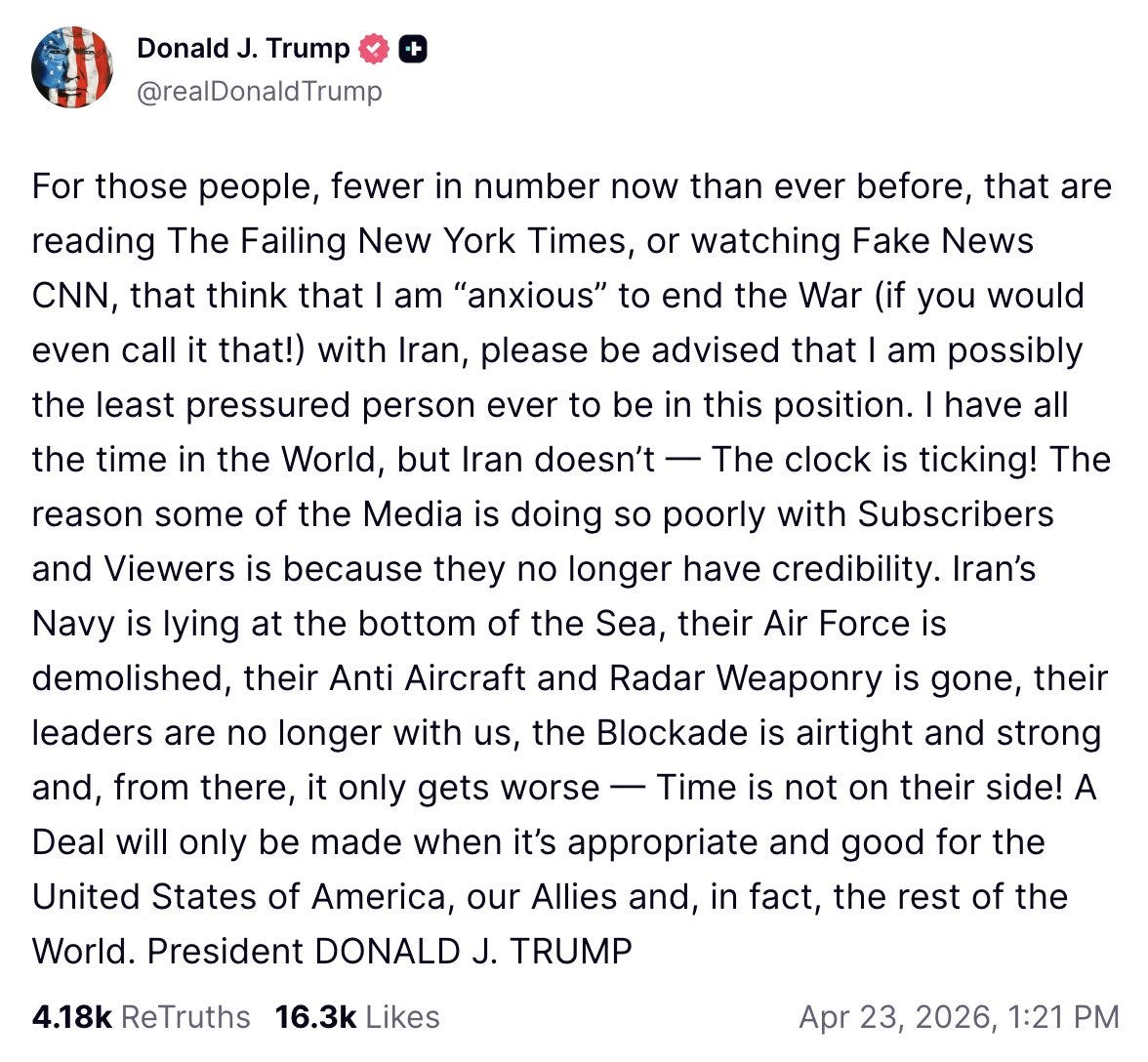
Supporting Trump’s claim that time is NOT on Iran’s side is this thread about oil storage on Kharg Islan (HT Simplicius):


Trump also claimed that Iranian leadership is divided in a phone interview with MSNow:
“They’re all messed up. They have no idea who their leader is. You know, we took out, really, three levels of leaders. And everybody that was even close behind him,” he said, referring to the late Iranian Supreme Leader Ayatollah Ali Khamenei. “So they have a hard time figuring out who the hell can speak for the country. They just don’t know.”
Trump is building on a western MSM narrative that the Economist and the Wall St. Journal kicked off last week.
CNN pushed back on that narrative with some expert quotes (archived):
“I think that’s a serious misreading of the Iranian leadership,” Mehrat Kamrava, a professor of government at Georgetown University Qatar, told CNN’s Becky Anderson. “The leadership has been quite cohesive, and we’ve seen this in the conduct of the war and the negotiation.”
…
“Different factions of Iranian leadership are more aligned now than before the war,” Trita Parsi, the executive vice president of the Quincy Institute for Responsible Statecraft, told CNN. “Because this is a much smaller circle … this circle is more united about the strategy they use in the war” compared to previous restrictions under Ali Khamenei.
Hassan Ahmadian, an associate professor of west Asian studies at the University of Tehran, denies there are any fractures in Iran’s leadership.
“The Iranian political system is very institutionalised. Name another system whose top echelon is assassinated and is capable of continuing and also waging a retaliatory war effort against two big foes. I do not see any historical parallel to this,” Ahmadian said.
He added: “For every institution in Iran there is a parallel institution and that makes it easier to withstand shocks.”
And Newsweek describes a unified messaging effort from Iranian leadership:
President Masoud Pezeshkian wrote that the claims of divisions were false, declaring that the country’s leadership and population were aligned in purpose.
“In Iran there are no ‘hardliners’ or ‘moderates,’” Pezeshkian posted. “We are all Iranians and revolutionaries. With ironclad unity of nation and state and obedience to the Supreme Leader, we will make the aggressor regret.”
His message echoed nearly identical language used earlier by Iran’s parliament speaker, Mohammad Bagher Ghalibaf, who described the country as bound together by “iron unity” and “complete obedience” to the supreme leader.
Foreign Minister Abbas Araghchi added to the pushback, writing: “The failure of Israel’s terrorist killings is reflected in how Iran’s state institutions continue to act with unity, purpose, and discipline. The battlefield and diplomacy are fully coordinated fronts in the same war. Iranians are all united, more than ever before.”
Taken together, the statements marked a rare, synchronized messaging effort from Iran’s top civilian and diplomatic leadership, appearing to directly counter Trump’s claim that Tehran was internally fractured.
As for whose side time is on, here’s Dr. Michael Hudson:


The Economist warns that “Global energy markets are on the verge of a disaster” (archived):
Fifty days into the Iran war the world has lost 550m barrels of Gulf crude—nearly 2% of last year’s global output. Every month Hormuz stays closed, the world misses out on 7m tonnes of liquefied natural gas (LNG), worth 2% of its annual supply. Yet in Western countries, which host the largest futures markets, pain remains limited. Petrol is a bit pricier, but most households can still afford to drive. Trucks keep trucking. Planes continue to fly. Fuel stocks remain close to pre-war levels.
This comforting picture is deeply misleading. By April 20th the last few oil tankers to cross Hormuz before the war began reached their destinations, in Malaysia and California. There is no buffer left to protect the world from the supply shock, at a time of the year when demand from holiday drivers starts to pick up.
To gauge how close the world is to energy catastrophe, The Economist has gathered a dashboard of indicators. It suggests that grave damage has already been done. Worse, without a reopening costs could soar, triggering events that cause the fuel system to seize up. A reopening of the strait now would—just—avoid a complete disaster. But some additional pain is already inevitable.
Three factors are pushing the world towards the cliff edge. Oil cargoes available to buy are drying up. Refineries are slashing output of fuel. And demand remains artificially high, especially in Europe. Something big must give somewhere large for energy markets to balance.
This confirms the argument Gideon Rachman made ten days ago for FT.com:
The Iranians believe that time is on their side in this confrontation and they are probably right. The longer the Strait of Hormuz is closed, the more the economic and political pressure on the US and its allies will mount. As a result, Iran’s negotiating hand is likely to be stronger — if and when peace talks resume.
The loss of some 20 per cent of the world’s energy supplies has already been called the “greatest global energy security threat in history” by Fatih Birol, the head of the International Energy Agency. He has warned that today’s crisis could dwarf the combined effects of the oil shocks of the 1970s — which caused several years of inflation, recessions and fuel rationing.
The economic impacts of the current war were cushioned for a while because a lot of oil and gas from the Gulf was already at sea when the US and Israel attacked Iran on February 28. But the effects of the strait’s closure — and of Iran’s attacks on Gulf energy infrastructure — are now really kicking in.
A rise in the price of petrol at the pump is just the beginning. A shortage of jet fuel will hit air travel, which will damage tourism just ahead of the crucial summer season in Europe. A lack of helium — much of which is produced in Qatar — could stop the production of semiconductors. Food production will be damaged by fertiliser shortages which will lead to further inflation. The Asian Development Bank has recently forecast that the energy crisis could reduce growth by more than 1 percentage point this year in developing Asia.
Trump clearly hopes that the economic pressure exerted on Iran through the blockade will force the Islamic republic to back down quickly. But the Iranian regime is resourceful, ruthless and fighting for its life. Iran also has a cushion of income generated by its recent oil sales at inflated prices and can generate some revenue through gas exports by pipeline.
Oh and aluminum supplies are wrecked, per Reuters:
“The scale of the supply shock we’re seeing in the aluminium market is probably the largest single supply shock a base metals market has suffered in the post-2000 era,” Nick Snowdon, head of metals and mining research at Mercuria, said on the sidelines of the Financial Times Commodities Global Summit in Lausanne, Switzerland.
“We are already in a ‘black swan’ event. No one could have foreseen something on this scale,” he told Reuters.
Concerns about supplies due to disruptions stemming from the U.S.-Israeli war with Iran fuelled a rally on the London Metal Exchange, pushing aluminium prices to a four-year high at $3,672 a ton on April 16.
Ian Welsh also argues that time is on Iran’s side:
Let’s keep this simple: every day the Strait of Hormuz is closed, more damage is done to the world economy. The US is not immune to this as it needs ammonia and helium: helium is used to make chips (which the US mostly does not make but does consume) and ammonia is vital for fertilizer…
Iran doesn’t actually need much from the rest of the world: they have enough oil, obviously, and they can feed themselves. Plus there are land routes open which are not interdicted. Iran, in less than a week, repaired all of the train bridges and track which had been destroyed by US and Israeli bombing.
So there’s no need to Iran to soak up more hits. Their big weapon is keeping the Strait closed and it is.
The US has resupplied massively, but Iran has used the time to clear the debris around their underground mountain bases, and is read for the next round. Launchers turn out not to be much of an issue: they’re just trucks with hydraulic lifts, after all. If the war does continue, Iran is ready, and they’ve made threats to hit the underwater internet cables around the Gulf, which would knock out internet to essentially the entire Gulf.
Overall I see no reason to change my original analysis, which is that Iran will win this war.
On the plus side, Trump did disavow the use of nuclear weapons:
“Why would I use a nuclear weapon when we’ve totally, in a very conventional way decimated them without it,” he said. “No, I wouldn’t use it. A nuclear weapon should never be allowed to be used by anybody.”
Enough about what Trump (and others are saying), let’s check in on what the US military is doing.
US Military Making Moves, Iranians Doing Deterrance Display
Jeff Bezos’ Washington Post reports on the arrival of new American aircraft carrier group (archived):
The arrival of the USS George H.W. Bush strike group, carrying thousands of additional American personnel and dozens of advanced fighter jets, was announced by U.S. Central Command, which oversees military operations in the Middle East. Its path to the region has been closely watched as a potential signal point while Trump seeks progress in the halting peace negotiations between Washington and Tehran.
The Bush has been traveling off Africa’s eastern coast. It was in the Indian Ocean on Thursday, Central Command said. Another 4,000-plus U.S. troops with the Boxer Amphibious Ready Group and its embarked Marine Corps task force, the 11th Marine Expeditionary Unit, are expected to arrive in the Middle East in coming weeks.
…
The Bush is joining the carriers USS Gerald R. Ford and USS Abraham Lincoln — adding to the scores of aircraft and warships both are carrying and complementing their air-defense and long-range strike capabilities.
This thread gives some idea of the disposition of US naval forces:


This thread on Iran’s mine-laying capabilities is worth a look:


Patricia Marins at Global 21 has a ‘big if true’ piece about Iran’s new air defense capabilities, although her sourcing is unclear and anything could be an op:
It’s got a lot of detail about specific improvements Iran has made to its air defense systems, anti-aircraft missiles the 358 and 359, and SHORAD (SHOrt-Range Air Defense Systems) Qaem-118 system, and several others.
She also discusses Russian media reports that they assisted Iran with repairs and replacements for certain systems in return for access to Iranian data about various US missile system.
It concludes:
Iran had serious difficulties keeping its medium- and long-range radars active during the first phase of the war, basically resorting to guerrilla-style operations with its units. Even so, it chose gradual deployment while keeping hundreds of SHORAD systems in protected installations.
…
I believe Iran possesses between 500-700 short-range air defense systems, which, in my view, performed poorly during the 40 days of war due to geographic factors and especially the cement particles, dust, smoke, and dense fog caused by the bombings. This drastically affects infrared and electro-optical sensors. The same conditions also affected coalition drone sensors and LEO satellites that were trying to locate Iranian launchers.This means that the more violent the bombardment, the lower the chances for Iranian air defenses, many of which I imagine are being deployed to positions near the coast.
Iranian air defenses were deployed gradually and shot down 24 American RQ-9 drones and an even larger number of Israeli drones; nevertheless, they had a weak performance against enemy aviation, shooting down only one fighter jet over their territory.
Let’s wait and see whether Iranian air defenses become more efficient.
But no one has questioned the effectiveness of Iran’s offensive missile capabilities and they’ve pushed out a new target list and a warning for Europe:


The hidden part of the post concludes:
This is a message to Europeans. Either your governments stops supporting the genocidal regimes in Israel and US or you will soon go back to use horse and carriage.
Iran will NO LONGER accept to be treated as a pariah state while trying its best to convince the world that it’s a nice/normal actor. The era of wasting time on persuasion of those who cannot be persuaded is Long Gone.
CNN quotes anonymous “US military officials” (archived) about their big plans to target the Strait of Hormuz:
The options, among several sets of target types under consideration, include strikes with a particular focus on “dynamic targeting” of Iran’s capabilities around the Strait of Hormuz, southern Arabian Gulf and Gulf of Oman, the sources said, describing potential attacks against small fast attack boats, minelaying vessels and other asymmetric assets that have helped Tehran effectively shut down those key waterways and use them as leverage over the US.
While the military has targeted Iran’s Navy, much of the first month of bombing was focused on targets away from the strait that would allow the US military to strike further inside Iran itself. The new plans call for a much more concentrated bombing campaign around strategic waterways.
CNN has previously reported that a large percentage of the country’s coastal defense missiles remain intact. Iran also has numerous small boats that could be used as platforms to launch attacks on ships, complicating US efforts to open the strait.
The piece also reviews long-standing US threats to target critical civilian infrastructure in Iran and adds a threat to return to the assassination campaign that started the war in February:
Another option developed by military planners is to target individual Iranian military leaders and other “obstructionists” within the regime who US officials have recently suggested are actively undermining negotiations, one of the sources noted. That includes Ahmad Vahidi, who serves as Commander-in-Chief of the Islamic Revolutionary Guard Corps, the source said.
This fit with threats coming from Israel, via Turkiye Today:
sraeli Defence Minister Israel Katz declared Thursday that the military is fully prepared to resume war against Iran and is waiting only for Washington’s authorisation, issuing the starkest threat Jerusalem has made since a fragile ceasefire took effect earlier this month.
“Israel is prepared to renew the war against Iran. The Israeli military is ready in defense and offense, and the targets are marked,” Katz said in a video statement released after a security assessment with senior military commanders.
He said Israel was waiting for a green light from the United States “first and foremost to complete the elimination of the Khamenei dynasty” and to “return Iran to the Dark Ages and the Stone Age” by destroying central energy, electricity, and economic infrastructure. “The attack this time will be different and deadly,” he added, promising blows “in the most painful places.”
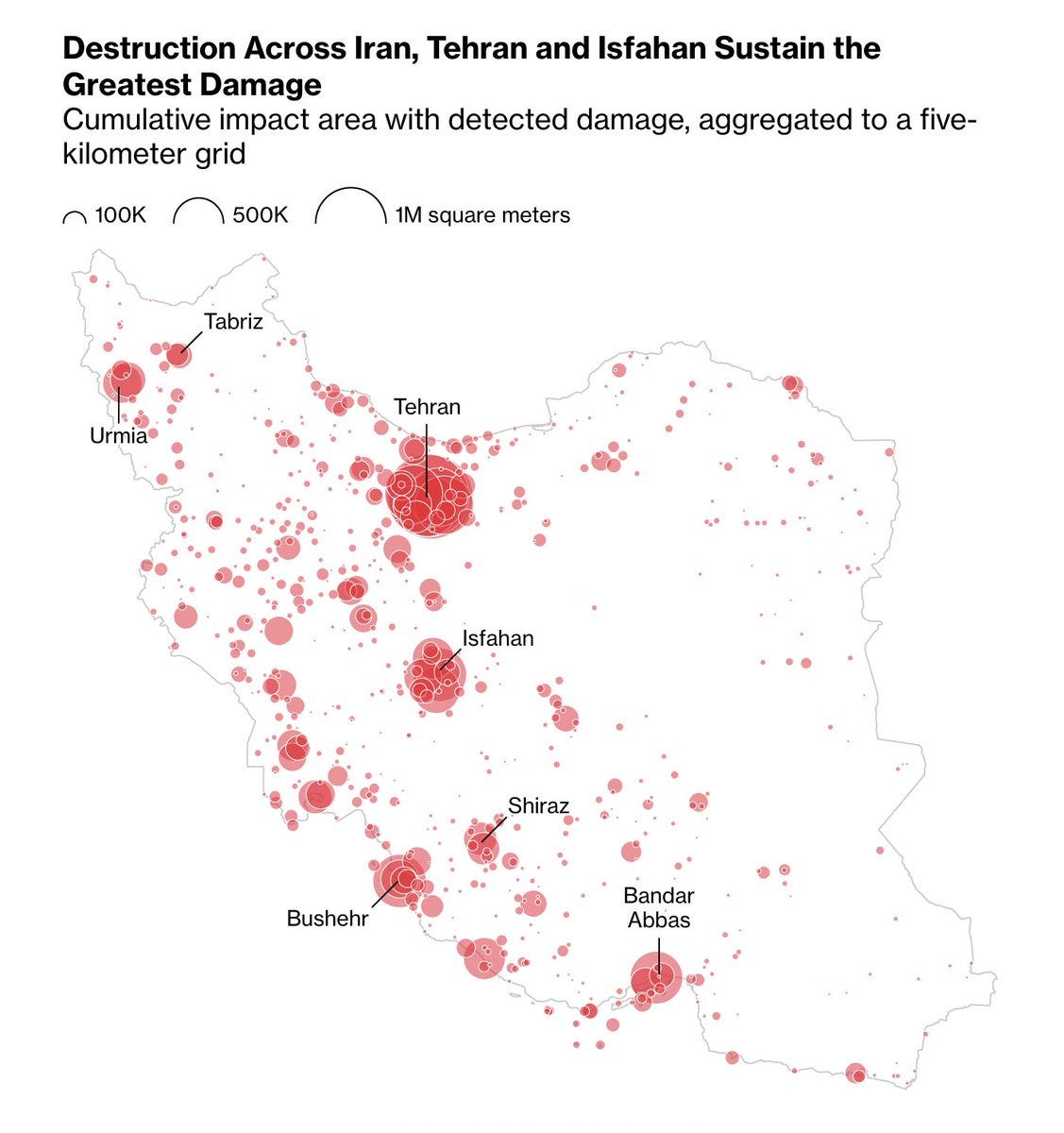
Regarding attacks on Iranian civilian infrastructure, Bloomberg analyzes satellite data (archived):
…a study by Conflict Ecology researchers at Oregon State University, which draws on radar imagery, estimates conservatively that at least 7,645 buildings were damaged or destroyed across the country — including 60 education and 12 health facilities — between the beginning of hostilities on Feb. 28 and the start of the truce on April 8.
…
Bloomberg News analyzed land use within damage clusters in Tehran, and found that 2,816 buildings were hit, around 32% of which were linked to the military, 25% to industry, 21% to civilians, while 19% were commercial and 2% governmental.
…
Last week, the Iranian government put total direct and indirect damage from the airstrikes at around $270 billion — not far off the International Monetary Fund’s estimate for the entirety of Iran’s 2026 gross domestic product of $300 billion. The IMF projects that inflation is likely to top 70%, setting a record for a country accustomed to eye-watering price rises.
They’ve got tons of maps and graphics in the piece, here’s one:
Now let’s look at the Levant.
More Grim News from Lebanon & the West Bank
Haaretz reports on looting by Israeli forces in Lebanon (AI translated from Hebrew):
Fighters testify to looting of civilian property in South Lebanon with the knowledge of commanders.
The phenomenon has expanded, among other things, because some of the military police posts that were placed at exit points from southern Lebanon to prevent looting were removed, and because no posts were placed at other exit points in the first place. The soldiers say that even the commanders who condemn the phenomenon are not taking disciplinary measures to eradicate it: “When there is no punishment, the message is clear.”
What they’re not stealing, they’re blowing up:


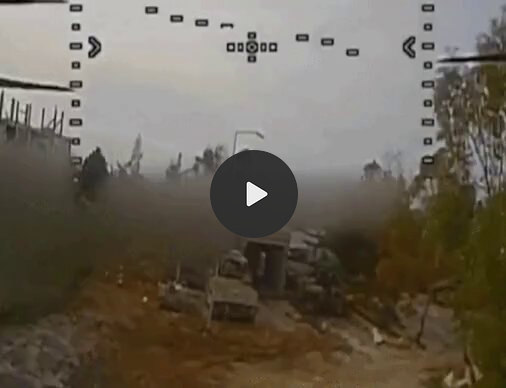
Hezbollah for their part is focused on Israeli military targets and is employing drone tech pioneered by Russian forces in the Ukraine:

The Israelis are enjoying US support for their latest predations in the West Bank, per the Jerusalem Post:
Israel’s advancement of settlement expansion in the West Bank is being undertaken with full US backing, Finance Minister Bezalel Smotrich told The Jerusalem Post on Tuesday, while speaking about his push for sovereignty over the entire area as the country marks its 78th Independence Day.
…
Smotrich said that all the actions taken in the West Bank had been coordinated with the president, along with US Secretary of State Marco Rubio and US Ambassador to Israel Mike Huckabee.Smotrich noted that while Trump had not yet supported the application of Israeli sovereignty over all parts of the West Bank, he hoped that “we will also succeed in that.”
“Even in the previous [US] administration, we did things, but certainly in the current one, we receive great support, full backing,” Smotrich said.
The Trump regime may be all-in on Israeli war crimes, but they do still care about fig leaves.
State Dept. Does Some CYA
The U.S. State Department published its legal defense of the war against Iran on Tuesday.
Rutgers Law professor Adil Haque commented on X, “it’s notable that collective self-defense of Israel comes first, individual self-defense of the United States comes second.”
He elaborated:
The statement concedes that the U.S. and Israel were *not* responding to an actual or imminent armed attack by Iran on Feb. 28.
Instead, they were already in an armed conflict with Iran, and were therefore free to attack Iran, any time, at will.
…the UN Charter prohibits the use of force except in response to an ongoing or imminent armed attack, including after a prior attack has clearly ended.
The point is to *prevent* a resumption of hostilities.
…
As the U.S. concedes, there was no ongoing or imminent armed attack by Iran.So the U.S.-Israeli attack on Iran is illegal. Simple as that.
But there may be a glimmer of hope.
Bibi on the Ropes?
Vox.com has a piece on Israeli Prime Minister Netanyahu’s re-election chances this year (archived):
…opposition parties are bullish on taking down Netanyahu — and defending democracy is central to their campaign.
…inside Israel, Netanyahu’s opponents are most animated by domestic issues: specifically, a fear that his ultimate aim is to demolish Israel’s remaining democratic institutions and stay in power indefinitely.
This is a reasonable concern. Netanyahu’s government has put cronies in charge of Israel’s security services, demonized the Arab minority, persecuted left-wing activists, and pushed legislation that would put the judiciary under his control. He is currently on trial for corruption — with the most serious charges stemming from a scheme to trade regulatory favors for favorable news coverage from a major Israeli outlet. President Donald Trump is actively pushing Israeli President Isaac Herzog, who holds a more ceremonial position, to grant him a pardon.
…
Polls consistently show that Netanyahu, who has been prime minister for all but one year since 2009, would lose his governing majority if elections were held now — and they’re required to take place no later than October. If these trends hold, then there is a real chance that he will be the next leader in the Trump-aligned far-right international to fall.
Here’s hoping, although no Israeli politician is likely to be much less genocidal or expansionist. The zionist project has its own awful logic after all.
Now let’s look at some other players who are trying to influence the course of the war.
Diplomatic Moves
The AP has a piece on China’s diplomatic role:
After the war began with U.S.-Israeli strikes on Feb. 28, Chinese Foreign Minister Wang Yi spoke with counterparts including Israel, Saudi Arabia, Bahrain and the United Arab Emirates. As of mid-April, he had 30 phone calls with various parties about the war, according to a tally of his calls from the Ministry of Foreign Affairs.
Wang also hosted his counterpart from close ally Pakistan, which has been acting as the main mediator in the latest talks, to present a five-point proposal calling for an end to hostilities and the reopening of the Strait of Hormuz.
Chinese President Xi Jinping in recent days has been uncharacteristically outspoken, warning last week against “the world’s retrogression to the law of the jungle.” This week, he called for the Strait of Hormuz to reopen.
George Chen, a partner at The Asia Group consultancy, said China’s role in the Iran situation is irreplaceable. As Tehran’s biggest oil buyer, its advice carries weight. China is also one of the few countries that has showed sympathy for Iran’s situation at the United Nations, he said.
Further, Iran’s ballistic missile program was built with Chinese technology, and China sells dual-use industrial components that can be used for missile production, according to the U.S. government.
Although China isn’t as immediately influential as Pakistan or key Arab Gulf states in active mediation, it occupies a unique position as the key economic partner for many of those countries.
Egypt tries to help Lebanon, per The National:
Sources in Cairo, as well as analysts, say despite its surprise at Lebanon’s decision to move ahead with direct talks with Israel, Egypt has been quietly advising on red lines that should not be crossed.
Cairo’s approach is to support the Lebanese state against both Israeli pressure and internal factions, while also positioning itself to counter, or pre-empt, any Israeli effort to impose a regional reality aligned with its extremist policies.
“Egypt’s deep interest in Lebanon is not a matter of diplomatic niceties,” said Nael Shama, a political scholar with an interest in Middle East politics.
“It is not just playing a superficial role,” he told The National. “There’s an involvement across state institutions, which signals it has serious and broad interests.” Cairo, he explained, had stepped up to support and engage with Lebanon before, but “not at this level”.
Egyptian Foreign Minister Badr Abdelatty travelled to Beirut on March 26, his fifth trip to the Lebanese capital in two years. He oversaw the delivery of 1,000 tonnes of aid and reaffirmed Cairo’s support for Lebanon amid a deepening humanitarian crisis.
Japan cuts deal with Mexico, via Nikkei Asia:
Japan will import 1 million barrels of crude oil from Mexico as soon as July under an agreement between the two countries’ leaders, it was learned Wednesday, as Tokyo takes a small step toward diversifying its energy supply away from the conflict-torn Middle East.
Japanese Prime Minister Sanae Takaichi spoke with Mexican President Claudia Sheinbaum by phone on Tuesday, requesting an increase in crude oil exports.
This is believed to be the first agreement between Japan and a foreign government to secure an alternative source of oil.
What’s On the YouTube?
Let’s wrap this up with a couple of YouTube segments that are worth a look.
Nima hosted Matthew Ho on Dialogue Works:
Ho argues that both sides may have reached a modus vivendi:
Matthew Ho: What we’re looking at is is a modus vivendi that has been agreed to tacitly. It’s just an unspoken agreement here that Donald Trump gets to declare victory in whatever form, the United States gets a way to withdraw from this war by saving face.
The Israelis get southern Lebanon.
The Iranians get sanction relief in the form of the control of the Straits of Hormuz. JP Morgan did an estimation a week or two ago. It found that that control of the Straits of Hormuz and Iran does the $1 per barrel of oil toll as they said they were going to do, that’s going to bring the Iranians $70 to $90 billion a year. That’s 25 or 30% of their GDP.
I think what you’ll see is a modus vivendi that everyone goes forward with as things are there’s occasional spouts of violence. They all get to declare victory which is what they’re all looking for. Then we go on with this until the next crisis for the Americans.
Ho also makes a strong argument that the American political system won’t be able to formally recognize this arrangement and that the US Democratic Party won’t be able to unify on an anti-Israeli position for five or ten more years.
Ugg.
Alastair Crooke guested on Daniel Davis’ Deep Dive and argued that Iranian has too strong a hand for things to stop now.
Alastair Crooke: The blockadefor Iranian tankers and Iranian vessels is not a total blockade at all.
I’ve seen all these reports about, ‘Iran is being deprived of oil (revenue), its economy is collapsing as a consequence.’
This is just sheer nonsense. It’s getting its oil out. It has various means for getting its oil out. I mean, it’s not just the Hormuz, don’t forget they have overland ability to export their oil and they have a loading site off out of Hormuz just doesn’t have a big throughput, but it has I think 350,000 barrels a day or something.
So, those vessels that you just said (have cleared the US blockade) have brought in probably close to a billion dollars.
In these period of the war, Iran has been earning double the revenue that it was earning even in the best months of the years previously. It is very well endowed with money.
Furthermore, before the war started, it put some 200 million barrels of oil at sea on vessels and it’s sold about half of those, I believe.
So they’ve got about a 100 million barrels still which they can sell to customers and take revenue and the revenues are not passing through the Gulf either through UAE financial structures which of course would be leaked immediately to the Americans. They they pass directly at the point of sale and through various means of which I am not familiar but I know are happening at the point of sale and so the the money is passing in Yuan (to Iran).
That’s enough for today.
Stay safe, y’all.
Originally published at NakedCapitalism on April 24, 2026.