

I’ve got to open today’s Iran War update with POTUS Trump’s latest claim that he’s opening the Strait of Hormuz to please China:
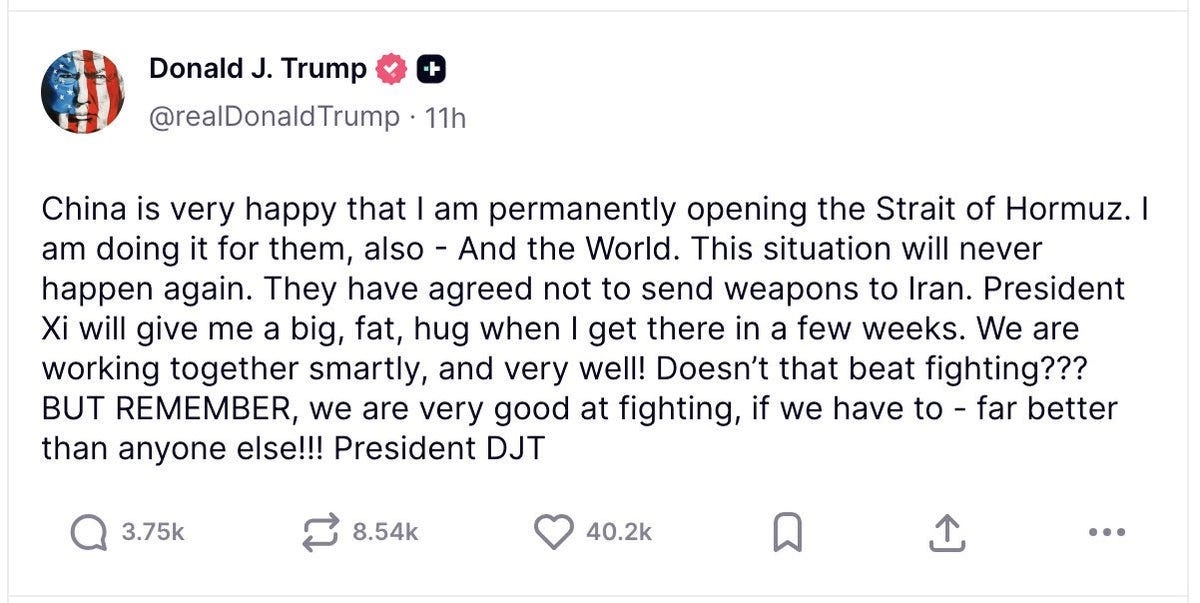
Impossible to discern if Trump’s statement actually means anything as for the “talks”, the NYT had a brief update:
Senior Pakistani mediators, including the army chief, Syed Asim Munir, arrived in Tehran on Wednesday for talks aimed at shoring up the cease-fire between Iran and the United States before it expires next week.
If Trump has ended his blockade of the Iranian blockade, it doesn’t appear Centcom got the memo:


But I’ve also got to follow the maxim “watch what he does, ignore what he says” so let’s look at this Washington Post report about troops moving “into the region”:
The forces moving into the region include about 6,000 troops aboard the aircraft carrier USS George H.W. Bush and several warships escorting it, said current and former officials, who like some others spoke on the condition of anonymity to discuss military movements. About 4,200 others with the Boxer Amphibious Ready Group and its embarked Marine Corps task force, the 11th Marine Expeditionary Unit, are expected to arrive near the end of the month.
The infusion of firepower appears likely to coalesce with warships already in the Middle East just as the two-week ceasefire is set to expire April 22. The troops will join the estimated 50,000 personnel that the Pentagon has said are involved globally in operations countering Iran.
The last video embedded in the bottom of the post features Marine Corps veteran Jim Webb discussing how many Marines would be needed to actually blockade Iranian shipping coming through the strait.
There was also belated confirmation from the US Navy of the loss of a quarter-billion dollar drone near Iran, via TWZ:
The U.S. Navy has finally confirmed that an MQ-4C Triton surveillance drone crashed back on April 9. The circumstances that led to the loss of the uncrewed aircraft remain unknown, but the incident has now been described as a mishap. The uncrewed aircraft had vanished unexpectedly from online flight tracking sites while flying over the Persian Gulf, but where exactly it went down is unclear.


Now let’s return to the land of delusion with a quick check in on the front page of the NY Times last night:
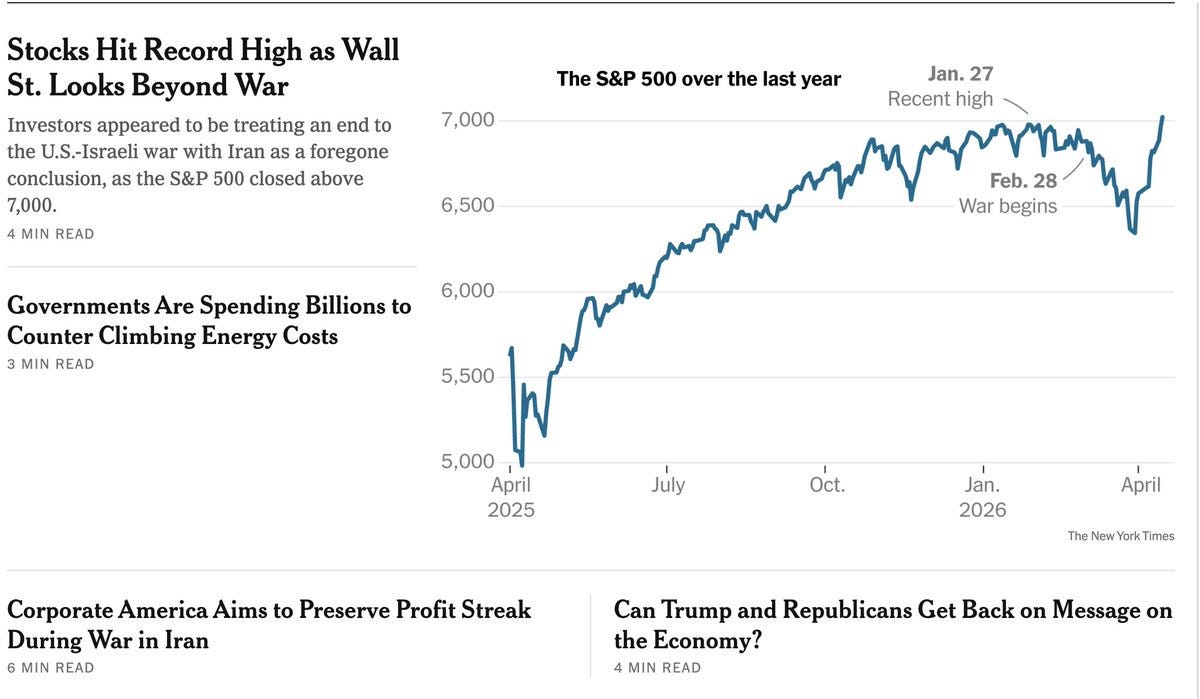
Party on Mr. Market!
While we’re looking through a glass darkly, no better place to get a beam in our eyes than Fox News repeating what Israel told them:
Nearly simultaneously, explosions tore through Beirut, Lebanon, the Beqaa Valley and southern Lebanon as roughly 50 Israeli aircraft struck more than 100 Hezbollah targets.
The targets were not rocket launchers or weapons depots, according to the Israel Defense Forces (IDF), but the nerve centers of the organization — command rooms, intelligence headquarters and offices where Hezbollah commanders planned the next stage of the fight.
“Within only a minute, the IDF eliminated 250 Hezbollah terrorists in three areas simultaneously,” the Israeli military said in a statement, adding the assessment is still ongoing.
Lt. Col. Nadav Shoshani, an IDF spokesman, told Fox News Digital the strike was the result of weeks of intelligence work.
Israeli intelligence agencies tracked Hezbollah operatives as they moved between apartments, offices and safe houses across Lebanon.
…
“The scale of the killing and destruction in Lebanon today is nothing short of horrific,” said United Nations Human Rights Chief Volker Türk. “Such carnage, within hours of agreeing to a ceasefire with Iran, defies belief.”
While we’re hearing brag and smack talk from the empire, let’s check in on U.S. Treasury Secretary Scott Bessant, via the AP:
Treasury Secretary Scott Bessent told reporters at a White House briefing Wednesday that the U.S. plans to ramp up economic pain on Iran, and said the new moves will be the “financial equivalent” of a bombing campaign.
The threat of secondary economic sanctions on countries doing business with people, firms, and ships under Iranian control — including allies like the United Arab Emirates and competitors like China — represents an escalation of sanctions that the U.S. is already employing.
Bessent said the administration has “told companies, we have told countries that if you are buying Iranian oil, that if Iranian money is sitting in your banks, we are now willing to apply secondary sanctions, which is a very stern measure. And the Iranians should know that this is going to be the financial equivalent of what we saw in the kinetic activities.”
The warning comes the day after the Treasury Department sent a letter to financial institutions in China, Hong Kong, the UAE, and Oman, threatening to levy secondary sanctions for doing business with Iran, and accusing those countries of allowing Iranian illicit activities to flow through their financial institutions.
Let’s let a little more reality intrude.
The NY Times featured this op-ed from David Wallace-Wells which allowed a little kinetic reality to intrude on its readership’s cozy world view:
American and Israeli forces were destroying quite a lot of Iranian targets, both military and civilian. But they were doing so with extremely expensive weaponry and depleting fragile stockpiles. Perhaps the Iranians were doing less damage, but they were doing it much more cheaply, with what seemed like a bountiful supply of low-cost drones, missiles and mines.
How long had it taken Americans to realize they’d gotten stuck in quagmires in Iraq and Afghanistan? In this war of choice, conducted largely by air, the fearsome U.S. military had gotten trapped in a war of attrition within the very first week.
In some ways, this is asymmetric warfare familiar from three-quarters of an imperial century, and an extension of the improvised explosive device counterinsurgencies of the war on terror. But it also marks what many defense analysts told me was a genuinely new era, brought about by new technology, which has rapidly undermined the military advantage of superpowers and their gold-plated weapons systems.
…
Pretty much every time an American interceptor missile destroyed a Shahed drone, it blew a hole in the U.S. military budget measured in millions of dollars. It blew one in the Iranian budget measured in the tens of thousands. And those were the encounters logged as American successes. When the drones and missiles did get through, they could take out a $500 million American surveillance plane.
Glad someone from the MSM is noticing what the alt-media concluded after the 12 Day War last June.
And there’s mounting evidence that Iran has upped its game in 2026, with help from their friends, via FT.com (archived):
Iran secretly acquired a Chinese spy satellite that gave the Islamic republic a powerful new capability to target US military bases across the Middle East during the recent war, according to a Financial Times investigation.
Leaked Iranian military documents show the satellite, known as TEE-01B, was acquired by the Islamic Revolutionary Guard Corps’ Aerospace Force in late 2024 after it was launched into space from China.
Time-stamped coordinate lists, satellite imagery and orbital analysis show that Iranian military commanders later tasked the satellite to monitor key US military sites. The images were taken in March before and after drone and missile strikes on those locations.
Now let’s look at domestic American political events related to the war. I’m not sure if chronicling Democratic impotence is worthwhile, please let me know in the comments.
First up, they went for the king with the 25th Amendment, via The New Republic:
Fifty House Democrats have officially filed legislation that would create a commission to jump-start the process to remove President Trump under the Twenty-Fifth Amendment.
The bill, introduced Tuesday by House Judiciary Ranking Member Jamie Raskin, would establish a “Commission on Presidential Capacity to Discharge the Powers and Duties of the Office,” a move that would allow Congress to complete its part in the Twenty-Fifth Amendment process. It also calls for the commission to hold “a medical examination of the President to determine whether the President is mentally or physically unable to discharge the powers and duties of the office.”
The bill essentially bypasses JD Vance, as Section 4 of the Twenty-Fifth Amendment requires either the vice president and the Cabinet or “such other body as Congress may by law provide” to determine the president is no longer fit for office.
Secondly, House Democrats move on Secretary of Defense War Pete Hegseth:
Yassamin Ansari, a Democratic congresswoman from Arizona, and colleagues including John Larson of Connecticut filed six articles of impeachment against Pete Hegseth on Wednesday, accusing the defense secretary of “high crimes and misdemeanors” in relation to the attack on Iran without congressional authorization, deadly strikes on suspected drug smuggling boats, sharing classified information on Signal and other official acts.
Finally, Senator Bernie Sanders tried to block U.S. funding of arms for Israel, seven Democrats crossed the aisle to keep the money for guns flowing, although their votes weren’t needed per The New Republic:
Senate Democrats on Wednesday refused to rally behind a joint resolution sponsored by Senator Bernie Sanders to block nearly $660 billion in weapons sales to Israel.
Seven Democrats joined every Republican in the Senate to vote against the resolution, which failed by a vote of 59-40.
The Democrats were: Chuck Schumer (NY), Chris Coons (DE), Catherine Cortez-Masto (NV), Kirsten Gillibrand (NY), Richard Blumenthal (CT), John Fetterman (PA), and Jacky Rosen (NV).
In diplomatic moves, Italy suspended its defense deal with Israel, per Reuters:
Italy’s Prime Minister Giorgia Meloni said on Tuesday her government had suspended a defence cooperation deal with Israel, reflecting frayed ties between previously close allies as the conflicts in the Middle East continue.
Meloni’s right-wing government has been one of Israel’s closest friends in Europe, but in recent weeks it has criticised its attacks on Lebanon, which have killed hundreds and injured thousands.Israel also fired warning shots last week at Italian troops serving in Lebanon under a U.N. mandate, causing damage to a vehicle.
Trump wasn’t happy and blamed the Pope, per PBS:
After chastising Pope Leo XIV, Trump turned his ire on Meloni, long one of his closest European allies, for calling his papal broadside “unacceptable” and not backing the U.S.-Israel war on Iran.
“I thought she had courage,” Trump said in an interview with leading Italian daily Corriere della Sera. “I was wrong.”
“I actually think this is a godsend for her,” said Nathalie Tocci, a professor at Johns Hopkins SAIS Europe and the director of the International Affairs Institute. “Trump has become completely toxic across Europe, across much of the world, including Italy.”
Trump doubled down on Wednesday, saying their bond had frayed. “She’s been negative,” Trump told Fox News. “Anybody that turned us down to helping with this Iran situation, we do not have the same relationship.”
Let’s hear from some YouTubers now.
Former US diplomat & former GOP Senate foreign policy adviser Jim Jatras was on with Col. Daniel Davis (above). He thinks Trump is preparing “what he hopes will be a knockout blow” and that “the only option (Trump has) is escalation.”
“We’re preparing another sucker punch of some sort using these negotiations as a cover for that,” Jatras said.
Davis then quotes Mohammad Marandi who says the Iranians are expecting that and are preparing to cut off the Red Sea and the Gulf of Oman.
Jatras admits that:
Whether the Iranians can be sucker punched or whether we will try to sucker punch them are two different things. I mean, I think that the people in Washington really think that they can catch the Iranians flatfooted again and hit and and use the negotiations as a cover.
…
I always have to ask myself, if the Iranians are so wised up to this, why are they still talking to these people? What is it that they hope to achieve? Is this just something to mollify the Russians or the Chinese or the Indians or whoever to say, “Well, no, no, we’re open to a diplomatic settlement. We’re trying to deescalate.” And they’re just going through the motions. Or do they really still hold out hope that’s some kind of a deal to be had?Just to give you an obvious example, part of any Iranian interest that would have to be codified in a deal would be lifting of sanctions. Can you imagine this Congress lifting sanctions on Iran?
…
We’re both sort of rummaging through our minds saying,’Well, what conceivably what target is there in Iran that is so valuable to them that it would amount to a knockout blow if we hit it?’I don’t know what it is. Now, you you say you don’t believe that they’re necessarily they’re they have something up their sleeve. They might not have anything up their sleeve that’ll work, but it doesn’t mean that they’re not thinking of something that they think will work.
Davis then points out that given the political climate in the US Senate dictates that “any submission at all by the president anything less than maximalist total demands giving nothing they’re going to push against (Trump).”
Jatras then asks:
Why do these countries negotiate (with the U.S.) knowing that the other side is not going to keep its side of the bargain if a deal is reached? That thoroughly puzzles me. I really don’t understand it.
I mean maybe they’re so deeply embedded in the normal world that the only way they can think of approaching an international problem is through classic diplomacy. you sit down with the other side, you try to negotiate.
He then references a discussion “by one of the other experts” that I believe refers to Col. Lawrence Wilkerson’s commentary on his most recent Dialoge Works appearance in which Wilkerson shared his shock at how unprofessional and slipshod Trump’s team in Islamabad was.
Jim Jatras: It was (Vice President JD) Vance and then the other two Pixies (Jared Kushner and Steve Witkoff) and they went there and this is not what you do if you have a real negotiation.
Look back when we negotiated START with the Soviet Union. You’d have all sorts of working teams and you know various experts on different issues and this and that.
We didn’t bring any of that to Islamabad. Of course not, because it’s not a real negotiation. We’re not negotiating anything we actually intend to abide by. So why would we bring a bunch of experts just spend their time spinning spinning wheels or something to come up with a lot of details?
They’re irrelevant to the exercise. I think basically both sides are going through the motions.
And speaking of Col. Wilkerson, the dude has been on fire lately, full of insight and telling anecdote PLUS he has great inside sources.
His appearance on Danny Haiphong featured some particularly sharp insights.
Wilkerson lays out the geo-strategic implications of China’s Belt and Road initiative and how it threatens to dramatically weaken the U.S. by speeding land transportation to the degree that shipping becomes much less relevant.
Wilkerson argues that a large part of the deep motivation for the Ukraine war was to cut Europe off from land-based trade with China.
He also emphasizes that the US and Israel have been bombing Iran’s rail connections with China “day and night.”
Then he discusses Turkey’s position:
Col. Lawrence Wilkerson: One of the countries of middling power, if you will, but nonetheless a power that’s caught in the middle of this and seems to not know what to do is Turkey.
And I don’t just mean Erdogan. I mean anyone that might replace Erdogan. [Foreign Minister Hakan] Fidan or whomever it might be.
I don’t think they know what to do. They have a number of directions they could move. They could just say to hell with NATO and to hell with the American Empire and move decisively into BRICS and join China and Russia.
Or they could somehow try to maintain a studied neutrality and divorce themselves over time from NATO.
Or, and this is the least possible one, they could remain in NATO, anchoring the southern flank, a flank that’s falling apart even as we speak, and try to make that work. But I don’t think that’s even a viable option for them. So, where do they go?
Then he gets into the disconnect, both in capabilities and interests, between Trump and the oligarchs who control him and the American political system.
Col. Lawrence Wilkerson: we’re looking at the whole scene of the world changing right now. And I don’t think anyone in the United States government of consequence has a clue.
They’re batting uh with a bad bat. They’re hitting 90 mph fast balls and fouling them off into the stands and that’s about all they’re doing. There’s no way they’re going to get a base hit, let alone hit a home run. And none of them know that.
The question in my mind is when and at what juncture in terms of this struggle the people who really are behind it and by these people I mean people (whose) names people would recognize like Elon Musk and Peter Thiel and so forth but there are quite a few names behind it that don’t have American names and they’re waiting to see when to jump ship and where to jump ship to. And I don’t mean that in terms of rats. I mean that in terms of the people who run the world.
I hope no one was bothered by the baseball analogy, I would normally have cut that kind of thing but it was important to the point he is making and very vivid imagery to those who know the game. Apologies to those who don’t.
One last quote from the Colonel where he brings it home it a way that would make Dr. Aaron Good proud.
Col. Lawrence Wilkerson: This is not a win/win situation as it should be for the two most powerful countries in the world, the declining one, the United States and the rising one, China. And with Russia on (China’s) side, considerably more powerful than she would be alone,it’s not a good deal.
(To) come back to what I talked about in the first moments of this interview, the business about Donald Trump wanting a way out and to extricate himself and why I said he doesn’t even understand this geostrategic rationale. He doesn’t.
But do you think the powers behind the throne are going to let Donald Trump get out of this war? And I’m not so sure that Bibi (Netanyahu’s) not one of those powers behind the throne. a despicable one, a murderous one, a homicidal one, a genocidal one, but nonetheless a smart one. And I’m not so sure he doesn’t know that, understand that. And he has connections with the Davos crowd. And so they’re not going to let Trump get out of this war until China is severely damaged. And I don’t see any way in the world that we severely damage China without severely damaging ourselves. in fact more so than we damaged China.
So where does this go? Even if it has a geostrategic rationale that makes sense, where does it go? And especially with a Trump who wants out by any method he can get out and declaration of a victory. It’s a nightmare.
I could quote a great deal more from Wilkerson’s insights but I should just encourage those who have time and interest to watch the whole thing.
I also need to recommend this Duran interview with Jim Webb for it’s discussion of the military details of an American blockade. Webb is a combat veteran.
Jim Webb: I was a marine. I was an infantryman in the Marine Corps. One of our um key onboard ship roles is called VBSS or vessel boarding search and seizure.
This is something that is very labor and marine intensive. You cannot just seize a ship with a handful of guys. Think about how big one of those tankers are and how much space you have to cover. It’s not a whole lot different in concept than clearing a building in an urban environment.
You need a lot of people to do it and then you need to hold it and then you need to drive it somewhere and do something.
So, the number of Marines which are in the Gulf right now capable of that are very limited. I would say probably about only 2 to 3,000.
You have the larger footprint, but your actual combat guys are a fraction of that, about one third of the overall troops that are deployed there.
This is the same problem we had with people talking about seizing terrain on the ground, too.
The blockade appears to be somewhat of a paper tiger overall. And this actually goes in direct contradiction with the laws of Laws of Armed Conflict that govern (Department of Defense) where you are not supposed to put a blockade in place that is in fact only on paper as it only inflames tensions.
In terms of the objectives of this it’s really hard to discern how you break a blockade. If you want to call what the Iranians are doing a blockade. it looks more like a toll to pay for the damage in their country over the last month.
But with another blockade the only logical conclusion that I can come to about what the Trump administration is thinking is that if they restrict travel through the strait, they will put enough pressure on Iran because somehow he perceives that the US has the moral high ground here and that the international community will come and back him up and force the Iranians to fully open the straight and drop their tolls and also perhaps give up their own sovereignity and control over that strait and the nuclear dust that they also possess. And quite frankly, that’s a fool’s errand.
The strait was open. It was toll-free until Trump decided to bomb Iran uh on behalf of the Israeli government uh a little more than a month ago. It’s a problem (Trump) created and this appears to be a very desperate attempt to force a solution that is not there.
Webb also shares some insights about the alleged rescue mission from the first weekend in April.
Firstly he notes the units that have been reported to have been involved. Then he points out that several of the units, like the Navy Seals and Army Delta Force, do not perform a search and rescue role — which is reserved for a particular Air Force unit — but rather specialize in offensive raids.
He speculates that multiple missions may have overlapped but ultimately concludes that the mission was doomed at the point they took a static position.
Webb finishes by speculating that the mission was a trial run for something larger and points out that “I think the memo was received by seeing the results of that operation. We lost more aircraft to hostile fire there than I think in the entire global war on terror.”
Dr. Robert Pape of the University of Chicago has blown up online since the war began. He has spent his career studying the American air war in Viet Nam, why it could never have achieved the American objectives and how America got trapped in the war in the first place.
He calls it The Escalation Trap. So far he’s mostly been on Breaking Points which is respectable but not really my vibe so I was curious to see him in the video above with Cyrus Janson who I know from videos he’s done with Alex White aka @Reporterfy (thanks Windall for finding his real name), but otherwise am unfamiliar with.
Janson seems to be Canadian and more interested in finance than the Breaking Points crew.
Here’s the outline of Pape’s appearance on the show with time stamps. I hope you find his schtick interesting as well as his knowledge. He may be a bit of a one-trick pony (we’ll see over time), but it’s kind of charming to see him dealing with his new online profile.
Pape has studied previous supply shocks and the economic fallout ensuing and uses that knowledge to explain what kind of after effects can be expected and when they might hit:
Dr. Robert Pape: The bottom line is that when you when you study blockades and these are economic blockades often in war and I’ve studied them for 30 years as part of my economic sanctions work, my air power work (which also looks at the naval blockades) you see a clear framework which is in the early weeks of a blockade what you end up with is disruption of goods that go in which increase the price of the good inside of the of the entity that’s being blockaded.
In this case, the world is being blockaded. So, it increases the price and the reason is because there’s stuff left in that uh country. There’s material, there’s stockpiles.
That’s why blockades increase price, but then after about four or five weeks, maybe 45 days, you get a different stage.
That’s the stage where those stockpiles run out. And that’s where you get true shortages. Now you’ve had fear of shortage. That’s why the price went up in the first 45 days. But after the first after 45 days, now you actually have shortages. And you really see those shortages materializing in South Korea, the Philippines.
Pakistan already going to 4 day work weeks now because there’re actual shortages occurring. Well, after the next stage beyond that, say days 60 to 90, you get to the third stage which is contraction of commodity production because you uh you don’t have some alternative supply source for 20% of the world’s oil, 30% of the world’s fertilizer. There’s nothing like that just sitting around waiting lying idle to be plugged in.
So what you end up with is a three stage which is price rise, shortage, contraction and I published this a few days ago and you see now we have the IMF coming out basically explaining this.
I’m comparing it to the 1973 in in these stages. So, so you can really see that in the 1973 oil shock almost identically the stages happen there too.
Same with blockade around uh Japan to get Japan to surrender in World War II.
There’s these three stages and once you understand the stages then you know what to look for at each stage as the hard indicators and that then gives you a heads up on the risk that’s coming and and so we’re at day 46 right now.
So we just passed day 45 and even that with the US military blockade in addition to the Iranian blockade there’s precious little going to get out of the Strait of Hormuz at this point.
Maybe it’s couple ships here and there but we’re not expecting a flood that’s for sure. So, what that means is that by May 1st, you’re going to start to see real shortages happen and they will start to be reported in the newspapers.
Then by June 1st, that’s when you’ll probably start to get the first actual reports of true commodity contraction. think producers producing less of furniture, producing less medical equipment, producing less automobiles. There will be generalized contraction as those that are are not just more expensive, they’re just not there.
So that is where the real rub comes and that’s why um uh you will see as much as they’re screaming and shouting right now we got to end this we got to end this wait till May 1st and then wait till June 1st and then this is going to then go on and that’s what happened by the 1973 oil shock that went on 151 days. That’s exactly the number of days it went on and that was enough to send the US economy into stagflation for eight years.
Originally published at NakedCapitalism on April 16, 2026.