

Two contrasting emails hit my inbox late Thursday night central time and epitomized the narrative conflict between the mainstream of American narrative control and alternative media over the current ceasefire in Trump’s Iran War.
On the one hand there was Gideon Rose’s piece for Foreign Affairs headlined “Why the Cease-Fire With Iran Will Hold” and subtitled, “The De-Escalatory Logic That Will Shape Negotiations”
And then there was Larry Johnson’s Substack newsletter headlined “Donald Trump and Scott Bessent Destroy Any Chance to Negotiate an End to the War with Iran.”
Rose, under the masthead of the Council on Foreign Relations argues the ceasefire will hold because:
In Iran, the endgame began with Trump’s threat of massive destruction if Iran did not open the Strait of Hormuz, and it will continue until the belligerents come to a stable agreement ending hostilities. The cease-fire is likely to hold for the same reason it was agreed to in the first place: both sides were hurting and would hurt even more if the war escalated instead of ending.
The Trump administration launched the war confident that the conflict would be relatively quick and cheap and that Iran wouldn’t be able or willing to hit back. Neither assumption proved true…
Trump’s ultimatum—threatening that “a whole civilization will die” if Iran did not capitulate—was almost certainly a bluff, because carrying out such an extraordinary threat would have been incredibly costly for the United States and risky for its allies in the Gulf, which remained vulnerable to Iranian counterattack. But since everyone knows Trump’s “madman” act isn’t entirely an act, the Iranians could not be sure Trump would cave. With neither side wanting to make the war total, both stepped back from the brink. And at that point, the war’s endgame began in earnest.
…
When the dust clears, Iran is likely to retain the potential for some sort of nuclear program, but the United States should be able to gain some restrictions on it. (Whether those restrictions will be more or less than the ones contained in the nuclear deal from which the United States withdrew in 2018 remains to be seen.) Some sanctions on Iran will be lifted; others may continue. The passage of ships through the Strait of Hormuz is likely to be restored, but on new terms that will probably advantage Iran.
Johnson is less sanguine and adds a lot of detail about Bessant’s declared economic war on China and Iran (which I covered in yesterday’s update):
Bessent revealed that two Chinese banks have already received formal letters from the US Treasury. The letters state that if the banks are found processing Iranian transactions, they face the risk of secondary sanctions. He declined to name the banks. This comes alongside broader Treasury letters sent to financial institutions in China, Hong Kong, the UAE, and Oman.
Bessent went on to accuse China of hoarding oil during the conflict (instead of helping stabilize global markets), limiting exports of certain goods, and continuing to buy large volumes of Iranian crude (historically over 90% of Iran’s oil exports, accounting for about 8% of China’s energy needs). He compared this to China’s behavior during COVID-19 (hoarding medical supplies) and its past threats on rare earth exports, calling it a pattern of unreliability. Bessent stupidly believes the US naval blockade of the Strait of Hormuz, combined with the sanctions threat, will cause China to pause or stop buying Iranian oil. He stated that China “will no longer be able to obtain oil from Iran” under the new enforcement.
To make matters worse, Bessent announced that the Department of the Treasury is canceling sanctions waivers on Iranian (and Russian) oil, targeting Iran’s oil transportation infrastructure and elite smuggling networks (including the Shamkhani family), and working to freeze Iranian leadership funds held abroad. Gulf states are reportedly helping expose hidden Iranian accounts.
There’s more on the China sanctions in Asia Times.
Time will tell who is correct.
But given the long and winding narrative wars yesterday (the less kino is happening on the battlefields, the more twists and turns Trump and the MSM are able to lead us through), we should probably start with the ceasefire news that dropped early Thursday.
Here’s POTUS Trump’s Truth social post that kicked off the day’s dreamweaving:
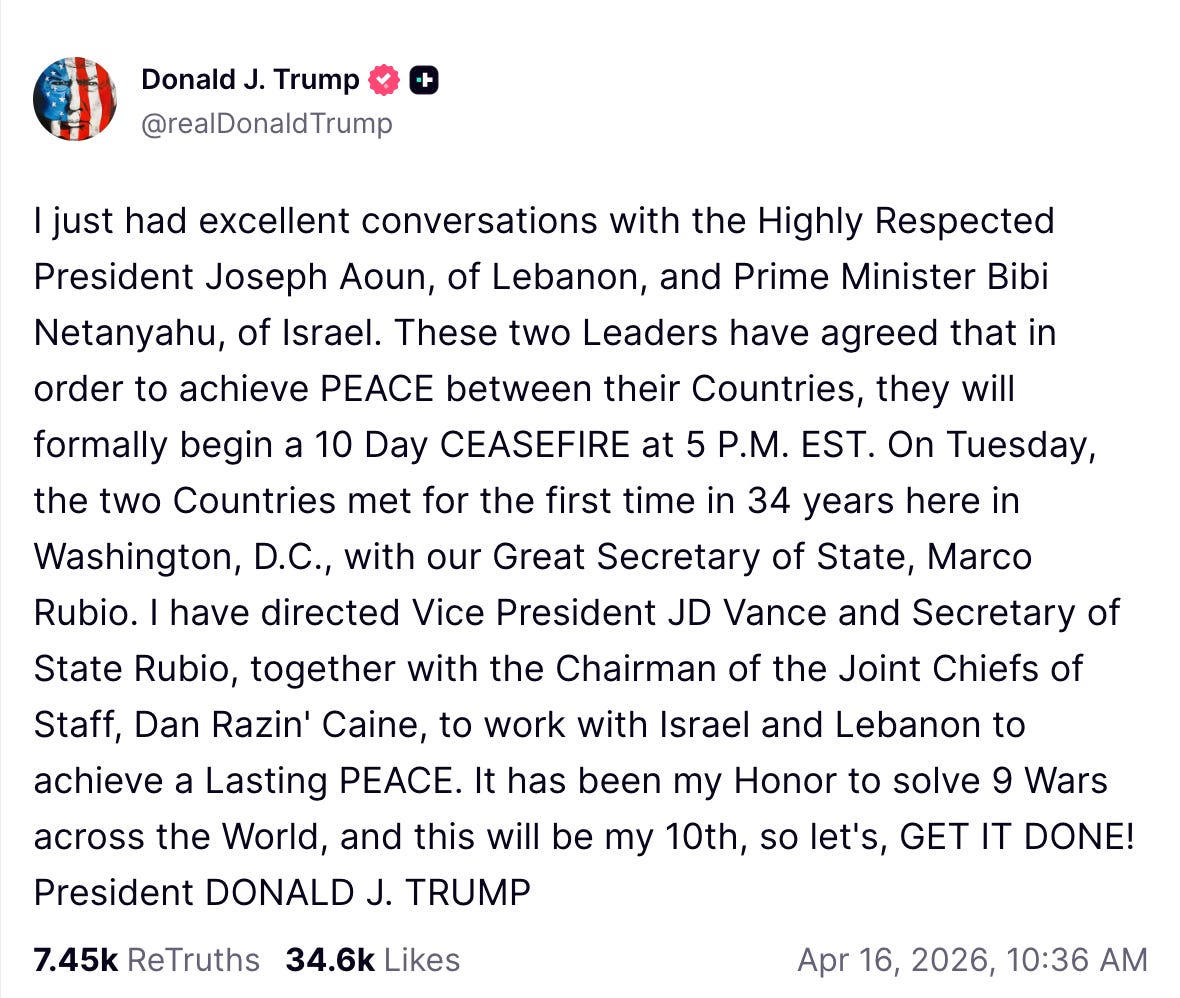
I just had excellent conversations with the Highly Respected President Joseph Aoun, of Lebanon, and Prime Minister Bibi Netanyahu, of Israel. These two Leaders have agreed that in order to achieve PEACE between their Countries, they will formally begin a 10 Day CEASEFIRE at 5 P.M. EST. On Tuesday, the two Countries met for the first time in 34 years here in Washington, D.C., with our Great Secretary of State, Marco Rubio. I have directed Vice President JD Vance and Secretary of State Rubio, together with the Chairman of the Joint Chiefs of Staff, Dan Razin’ Caine, to work with Israel and Lebanon to achieve a Lasting PEACE. It has been my Honor to solve 9 Wars across the World, and this will be my 10th, so let’s, GET IT DONE! President DONALD J. TRUMP
I presume he’s using “highly respected” to describe President Aoun the way Joe Biden used to use “completely unprovoked” to describe Putin’s invasion of Ukraine.
In addition to the statement just issued, I will be inviting the Prime Minister of Israel, Bibi Netanyahu, and the President of Lebanon, Joseph Aoun, to the White House for the first meaningful talks between Israel and Lebanon since 1983, a very long time ago. Both sides want to see PEACE, and I believe that will happen, quickly! President DONALD J. TRUMP
The New York Times added some deets:
Hezbollah acknowledged the cease-fire in a pair of statements on Thursday, but did not directly address whether it would accept the truce, saying its actions would be “based on how developments unfold.”
Israel and Hezbollah continued to trade strikes in the hours before the cease-fire was set to take effect, according to statements from each side.
The U.S. State Department, outlining the truce in a memo on Thursday, said that Israel would retain its right “to take all necessary measures in self-defense” but would not carry out “offensive operations” against Lebanese targets by land, air or sea. The Lebanese government, with international support, is expected to take “meaningful steps” to prevent Hezbollah from carrying out attacks against Israeli targets…
That last bit sounds ominous and like and impending double-cross against Hezbollah by the Lebanese government.
But I’ll believe that the feckless Lebanese Army will go at Hezbollah when I see it reported. In the meantime there’s a ceasefire to explain.
To do that I’ll quote Kit Klarenberg’s interpretation of events, which is obviously heavily biased in favor of Hezbollah, because I presume readers can get anti-Hezbollah agitprop in any MSM publication (and more nuanced discussion right here in the NC comments from Aurelian and others):
On March 23rd, Tel Aviv’s finance minister Bezalel Smotrich – a self-proclaimed fascist – urged the ZOF [what Klarenberg calls the Israeli forces…Nat] to formally annex southern Lebanon. Since then, over a million people have been displaced, thousands killed, and civilian infrastructure razed en masse. While a significant chunk of the country is now occupied, the cost for Tel Aviv was substantial. Unrelenting Hezbollah fire produced heavy casualties and record equipment and vehicle losses, including 21 Merkava main battle tanks in a single day on March 26th.
On April 2nd, Israeli media openly advertised the impending ceasefire in the war on Iran. It was revealed the Zionist entity was preparing to intensify its air campaign against Lebanon, due to the enormous damage inflicted upon the ZOF by the Resistance.
On April 5th, the ZOF’s Northern Command chief admitted Tel Aviv had grossly overestimated damage inflicted upon Hezbollah during its October 2024 invasion of Lebanon. Entity political and military chiefs had long-claimed the Resistance faction was obliterated by the illegal intervention. The ZOF estimated 70 – 80% of Hezbollah’s rocket capabilities were destroyed during the conflict. This reverie was comprehensively shattered by hundreds of the group’s projectiles successfully targeting Tel Aviv daily, throughout the Zionist-American war on Iran.
No wonder that conflict is now on hold. Hezbollah remains a redoubtable adversary, which can independently, and in tandem with its Resistance comrades, thwart Tel Aviv’s seizure of Lebanese territory, and permanently expel Zionist settlers from northern Palestine.
…
Then on April 3rd, the ZOF openly admitted “its goal of disarming Hezbollah” was “unrealistic, as it would require the military to launch a full-scale invasion of Lebanon,” which Tel Aviv wasn’t able to wage. In other words, the Resistance was undefeated, and Lebanese territory couldn’t be stolen. Having been engaged in perpetual, multi-front war since October 7th 2023, the exhausted Zionist entity lacked the muscle to achieve its Lebanese goals while also targeting Iran, contrary to intelligence, military and political forecasts.
There’s also an interesting Israeli strategic memo Israeli doctrine “Queen of the Jungle? On the Role of Israel’s Military Power in Establishing a New Regional Order in the Middle East” by a Brigadier General and a Lt. Colonel who recommend modifying the IDF “to the role of a regional protective force with prolonged and continuous operational capability throughout the Middle East. The IDF is required to adopt a new strategy that recognizes this and to change in a way that will give it the freedom of action, the pace of operations, the breathing space and the operational advantages it needs to fight simultaneously in several theaters, near and far.”
Do the Israelis sound ceasefire capable?
And I’ll wrap the ceasefire section with a NYT op-ed preceded by some quotes from Ehsan Safarnejad, a self-described “Iranian guy trying to debunk the propaganda that’s published by Western MSM on his country” from his conversation with Fiorella Isabel regarding Iran’s decision to accept a ceasefire and negotiate with the “agreement incapable” U.S.:
Ehsan, while personally opposed to the ceasefire, offered a more layered defense of Iran’s decision to participate in the talks, arguing that the ceasefire emerged not from weakness but from a strategic calculus following an IRGC threat to target Persian Gulf monarchies if U.S. infrastructure strikes proceeded. He also pointed to China’s veto of a Security Council resolution to open the Strait of Hormuz, suggesting Beijing may have pressured Tehran into negotiations in exchange for diplomatic cover—which also benefits them because they are severely affected by closing the Strait of Hormuz.
Ehsan can also be seen on a recent episode of Syriana Analysis with Kevork Almassian.
And here’s that NYT piece which handwrings about “Why China Won’t Lean Hard on Iran“:
China, even as it grows more concerned about the war’s impact on its economy, has avoided becoming too entangled in the crisis. That includes being noncommittal in its response to Tehran’s calls for China to guarantee its security, as well as not using its influence as Iran’s largest trading partner to push the country to accept U.S. demands.
Asking China to pressure Iran is to “misread China’s foreign policy and position,” said Ding Long, a professor at the Middle East Studies Institute of Shanghai International Studies University. “Helping the United States or Israel is not China’s intention because China opposed this war from the very beginning.”
Gee, ya think? Maybe that’s related to China’s ever-improving poll numbers with Americans.
But maybe China is helping Iran, at least that’s what this very thinly sourced CBS News report quotes some anonymous U.S. military officials as saying:
U.S. officials, who spoke to CBS News on the condition of anonymity to discuss national security issues, said Beijing had considered supplying Iran with X-band radar systems. This technology would significantly enhance Iran’s ability to detect and track incoming threats, like low-flying drones and cruise missiles, and could help protect its air defense systems against advanced strikes.
It remains unclear whether China ultimately moved forward with the transfer but the assessment underscores Washington’s concern that the Iranian war is drawing in not only regional adversaries but also global competitors willing to provide critical support, short of direct military involvement…
I feel stupid just for quoting two paragraphs of that.
Now let’s look at what the U.S. military is up to, or at least what Secretary of Defense War Pete Hegseth is talking about.
“Our forces are maximally postured to restart combat operations should this new Iranian regime choose poorly and not agree to a deal,” Mr. Hegseth said during a briefing to reporters at the Pentagon. “We are locked and loaded on your critical dual-use infrastructure, on your remaining power generation and on your energy industry.”
“We’d rather not have to do it,” he added, “but we’re ready to go at the command of our president and at the push of a button.”
Under international law, intentionally targeting a country’s energy infrastructure could constitute a war crime.
…
Mr. Hegseth said that the blockade would last “for as long as it takes” and that “if Iran chooses poorly” by not agreeing to a deal with the United States, “then they will have a blockade — and bombs dropping on infrastructure, power and energy.”The defense secretary also called out journalists who are reporting on the war, comparing them to the Pharisees who criticized Jesus of Nazareth for performing miracles.
“The Pharisees scrutinized every good act in order to find a violation,” Mr. Hegseth said, “only looking for the negative.”
The actual efficacy of the U.S. blockade atop a blockade remains very opaque and hard to parse.
The A.P. says the blockade is working and has some details that I should have included in yesterday’s report:
On Tuesday, the first full day of the blockade, only eight vessels, most of them linked to Iran or sanctioned, transited the strait, said Ana Subasic, trade risk analyst at data and analytical firm Kpler. The environment is still considered “extremely high risk” despite the ceasefire, she said.
“Most of the vessels have appeared to halt or have reduced movement after clearing the strait,” she said, “which tells us that the effect of the blockade is starting to show up because most of these vessels that have crossed have some kind of history with carrying Iranian-origin sanctioned cargo.”
The Rich Starry, a Chinese-owned tanker previously sanctioned by the U.S. for smuggling Iranian petroleum products, left the strait and then turned back this week, according to publicly available ship tracking data.
On top of Wednesday’s Reuters report of two ships turned back by the U.S. Navy, we do have another confirmed interdiction on Thursday:


But then there’s this which seems to confirm the U.S. blockade is as porous as analysts like Jim Webb and Larry Johnson have told us to expect:
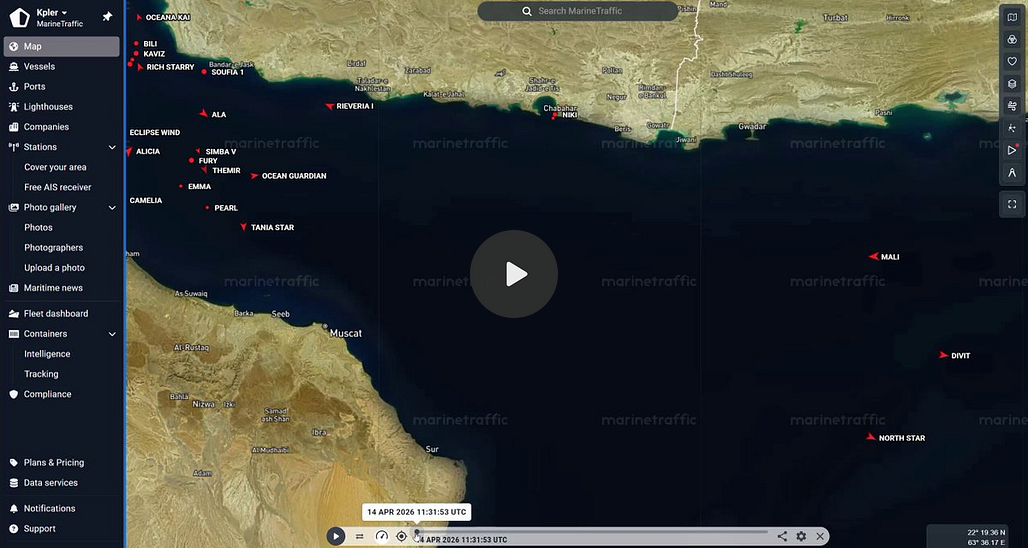
We also have some open source reporting on moves by U.S. aircraft carrier groups:


And this:


USA Today has corroboration of the short rations on board US ships but adds more about the collapse of mail delivery to said troops:
The U.S. Postal Service temporarily suspended mail delivery to 27 military ZIP codes after the United States and Israel attacked Iran. The Army said there is no end date in sight for the suspension, despite a ceasefire in the war.
The Postal Service and the Military Postal Service Agency have suspended deliveries as of the beginning of April “due to airspace closures and other logistical impacts from the ongoing conflict,” Maj. Travis Shaw, an Army spokesperson, told USA TODAY. Mail already in transit when the suspension took effect is being held in secure Postal Service or military facilities “for future delivery once service resumes,” he said.
The suspension is “in effect until further notice,” Shaw added. “Resumption of mail service is contingent upon the reopening of airspace by civil authorities, and the area commander’s evaluation of regional transportation and distribution stability.”
No mail is being “returned to sender” for those ZIP codes, Shaw said.
Wow, that’s beyond a material shortage and on to organizational collapse. Presumably involved with the panicked abandonment of multiple US bases in the region during the war.
The above point to the organizational and material weakness of the vaunted American military machine. I missed this WSJ story yesterday but Richard Wolff pointed it out on Nima’s show, but it points to a dramatic weakness on the U.S.’s part.
Senior defense officials have held talks about producing weapons and other military supplies with the top executives of several companies, including Mary Barra, chief executive officer of General Motors, and Jim Farley, CEO of Ford Motor, according to people familiar with the discussions.
The Pentagon is interested in enlisting the companies to use their personnel and factory capacity to increase production of munitions and other equipment as the wars in Ukraine and Iran deplete stocks.
Somehow team Trump decided to go to war before assessing its weapons stocks and securing supplies. How did the Department of Defense War come to this pass?
Oh yea, Greasy Pete Hegseth. Somehow he’s seen as the most vulnerable key player in Trump’s regime.
Which means people are watching for coups and counter-coups in the Pentagon, The Washington Post has a report alleging that “Republicans in Congress back Army secretary amid clash with Hegseth” (archived):
House Republicans on Thursday threw their support behind Army Secretary Dan Driscoll and lamented the recent ouster of the service’s top general, making a rare public break with Defense Secretary Pete Hegseth after his repeated clashes with senior Army leaders.
…
The rivalry between Hegseth and Driscoll dates to at least last spring, when a series of missteps by Hegseth fueled speculation within the Pentagon that President Donald Trump might replace him with Driscoll. Hegseth has since been cool in his public support for Driscoll, and others aligned with the defense secretary have questioned whether Driscoll is fully supportive of Trump’s agenda.
…
Thursday’s hearing occurred as tensions between Driscoll and Hegseth appeared to reach a crescendo this month after the abrupt ouster of (General Randy) George and two other Army generals, the latest in a string of senior military leaders who Hegseth has either fired or forced into retirement — often with little or no public explanation. While past defense secretaries have on occasion fired service secretaries with whom they disagree, Driscoll appears to be held in well regard at the White House and is a close friend and former Yale Law School classmate of Vice President JD Vance, officials have said.
While we’re talking about D.C. politics let’s look at the failure of American Democrats to pass a vote requiring POTUS Trump to get Congressional approval for his illegal war on Iran.
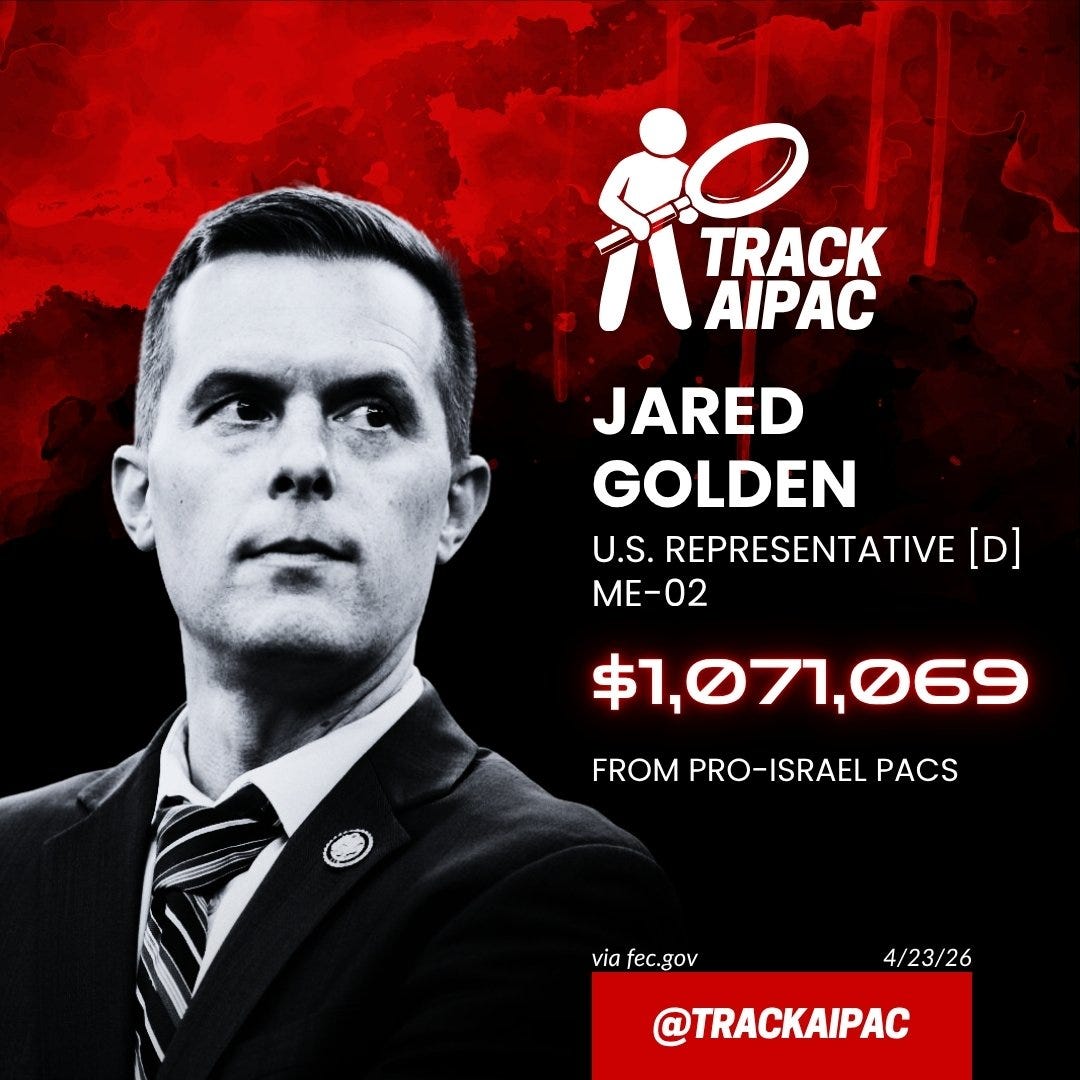
More Perfect Union broke the news: “The House just failed to pass a resolution to end Trump’s war with Iran by one vote. The count was 213-214. Just one Democrat, Jared Golden, voted to let Trump keep waging the war.”
And who’s this Rep. Jared Golden you may ask? AIPAC Tracker has the only data point needed:
The NY Times had more deets on the vote:
Two Republicans again broke with their party: Representative Thomas Massie of Kentucky was the only G.O.P. lawmaker to vote in favor of the resolution, while Representative Warren Davidson of Ohio, who previously backed a similar measure, switched his vote to “present,” declining to register a position. Representative Nancy Mace, Republican of South Carolina, who said she has “grave concerns” about the handling of the war, did not vote.
Mr. Davidson’s switch and Ms. Mace’s absence allowed Republicans to narrowly defeat the measure after three Democrats who had opposed an earlier version switched to supporting it: Representatives Greg Landsman of Ohio, Henry Cuellar of Texas, and Juan C. Vargas of California. Representative Jared Golden of Maine was the lone Democrat to vote against it.
The Times also quotes Rep. Brian Mast (R-FL), the Republican chairman of the Foreign Relations Committee saying a re-do of the vote could “have a different vote count after 60 days, alluding to a May 1 deadline that falls 60 days after Mr. Trump formally notified Congress last month of the military operation in Iran.”
Our more credulous readers might enjoy this Axios report about the Democrats’ new strategy to force a daily War Powers vote.
Ken Klippenstein has an important reminder about the War Powers Act:


Glenn Greenwald reposted a 2010 piece he wrote for Salon that is just as valid today:
This is what the Democratic Party does; it’s who they are. They’re willing to feign support for anything their voters want just as long as there’s no chance that they can pass it.
…
The primary tactic in this game is Villain Rotation.…the designated Villain constantly shifts, so the Party itself can claim it supports these measures while an always-changing handful of their members invariably prevent it.
In this case, the rotating villain was a lowly House member who’s not running for re-election. I wonder what he and his campaign consultants will do with all that hard-earned AIPAC money?
Now let’s switch up and cover some war-related tech news.
First up, Starlink, via Reuters:
Last August, U.S. Navy officials carrying out a test of unmanned vessels realized they had hit a single point of failure: Starlink. A global outage across Elon Musk’s satellite network affecting millions of Starlink users had left two dozen unmanned surface vessels bobbing off the California coast, disrupting communications and halting operations for almost an hour.
The incident, which involved drones intended to bolster U.S. military options in a conflict with China, was one of several Navy test disruptions linked to SpaceX’s Starlink that left operators unable to connect with autonomous boats, according to internal Navy documents reviewed by Reuters and a person familiar with the matter.
…
the Navy’s mishaps with Starlink for its autonomous drone program, which have not been previously reported, highlight the challenges of the U.S. military’s growing reliance on SpaceX and the risks it brings to the Pentagon.
And this NYT piece on Iranian hackers:
Iran has combined real-world attacks, disinformation and a mix of low-level and more advanced cyberattacks to create confusion in Israel. In the United States, it temporarily caused a global, companywide shutdown at a major medical-equipment supplier, Stryker, scoring a major success that surprised some security analysts.
A group affiliated with Iranian intelligence also took responsibility for the release of emails and photographs stolen from a personal account of Kash Patel, the F.B.I. director.
Now in the cease-fire, Iran is tactically shifting from overt demonstrations meant to undermine support for the U.S.-Israel campaign toward quieter efforts to prepare for what might come next. This new phase of cyberspace operations includes a greater focus on espionage.
Iran has continued to target individuals in the United States and Israel who are either government officials or linked to the government. Its hackers have also stepped up its efforts to penetrate critical infrastructure, attempting to get access to water and power systems in the Middle East and the United States as part of an effort to prepare for future operations that would cause societal pain…
I hope everyone is appropriately alarmed.
If not, here’s something that’s actually scary and much better sourced:

I’ll be back tomorrow with another Iran War update.
Originally published at NakedCapitalism on April 17, 2026.