Been busy at Naked Capitalism this week. Monday, I wrote about the Ellison Media empire:
Ellison Empire Settles on Skydance, Takes Big Bond Price Hit, Names Team
Having cleared the biggest legal hurdle, the Ellison media empire has assumed control of WBD, dumped all over the bond markets, and named its leadership team for the new organization which will be called Skydance after David Ellison’s studio.
Let’s start with legal case closing.
Cases Closed, WBD Goes to the Ellisons
Judge Araceli Martinez-Olguin ruled Wednesday to approve the agreement, which was reached as part of the states’ antitrust lawsuit seeking to block Paramount and Warner Bros.’ merger.
Her ruling means the settlement agreement can take effect and Paramount and Warner Bros. can close their deal, as the merger had already received government approval from the U.S. and other countries.
Martinez-Olguin ruled the settlement “represents a reasonable factual and legal resolution of the dispute,” is “procedurally sound” and was reached fairly between the parties.
The settlement agreement requires Paramount to produce 30 to 32 films for the next five years, a certain share of which have to be produced in the U.S., and imposes other requirements like mandating Paramount and Warner Bros. negotiate their channels’ cable packages separately and establishing an “independent editorial board” to oversee CNN and CBS News.
David Sirota had a beautiful riff on The Left Hook about the cynicism of California Governor Gavin Newsom successfully pressuring California AG Rob Bonta into essentially conceding the case against Paramount while positioning himself as the leading anti-Trump Democrat:
David Sirota: …the Democratic attorneys general, 12 of them, had the chance to really prevent a kind of total takeover of the media by Donald Trump’s allies, billionaires, right? The true oligarchy of the oligarchy.
And what ended up happening instead was Gavin Newsom, who had originally appointed Rob Bonta AG, Gavin Newsom came out very hard and said, “I don’t think the AGs should block this.”
And Rob Bonta reversed himself and did a settlement. A settlement that included (this is an important point, it’s a legal point) no structural remedies.
And when you hear that term, what that means is the settlement has all of these alleged pledges of behavioral changes, like, you know, the studios will do this, they’ll set up an independent journalism board. I call them the inshallah pledges. Right. It’s like, these will behave nicely, right? Right.
Structural remedies, which were not in the settlement, are: we’re going to sell off this, we’re going to divest that, so that we don’t control everything. A lot of times, antitrust settlements include structural settlements so that what is being created in the wake of a merger isn’t a monopoly. There were no structural remedies in this.
So pull back a second, and what you see is that the Democratic leaders of one of the most Democratic states in the country handed over a giant segment of the already consolidated information ecosystem that we live in, the media ecosystem that we live in. They handed it over to Donald Trump’s oligarchs.
So what’s amazing to me, I mean, the sociopathy, Gavin Newsom here is actually, I struggle to find words for it, because this is a person who is concurrently going out into public saying, “I am Mr. Anti-Trump. I am the face of the resistance.” And the face of the resistance simultaneously handed over a media empire, effectively.
And now on to the bond market reaction.
Many Billions in Paramount Debt Hits the Market Hard, Mr Market Cries Out
The Wrap reported on Paramount’s debt offering on September 28:
The debt offering, which was filed with the SEC on Monday, includes $32 billion in investment-grade debt and $12.4 billion in high yield bonds. The proceeds from the debt offering will be combined with equity and term loan financing as well as cash on hand to fund the $110 billion purchase of Warner Bros. Discovery.
Read the rest at Naked Capitalism.
I also wrote about Meta’s Muse:
Meta Makes Its Agentic AI Move With Muse
Mark Zuckerberg’s Meta, owners of Facebook, WhatsApp, and Instagram, have made an aggressive push into the AI market with Muse, an “agentic AI” product that is rapidly racking up downloads, claiming big user numbers and pushing past ChatGPT while it has safety experts warning of serious dangers to users.
What Is Muse?
Per Meta’s September 8th product announcement:
Muse is a personal AI agent. It doesn’t just answer questions, it actually does the work. It helps people stay on top of things, takes tasks and projects off their plate, and turns long-term goals into action plans.
Meta built Muse from the ground up to be a safe, secure, private, and widely available personal AI agent.
Muse runs on Muse Secure VM, a dedicated secure computer with its own browser, and can work on a person’s behalf across the apps they use daily, learning from conversations, reflecting on what matters to them, and getting sharper along the way.
Each person stays in control of their Muse and decides how much access it gets.
For a deeper look at how Muse was designed and how safety, security, and privacy were built into it, read How We Built Safety Into Muse and How We Designed Muse.
TechCrunch immediately pointed out some of the consumer trust hurdles Meta will have to overcome to achieve significant user adoption of Muse:
Less than two weeks after Meta agreed to a massive $18 billion multistate settlement in a lawsuit over social media’s consumer harms, the company announced its biggest bet on consumer AI to date — and one that requires significantly more trust than social media ever did. On Tuesday, the company introduced Muse, its new personal AI agent that helps consumers with everyday tasks and projects for users in the U.S.
To use Muse, consumers will have to trust Meta with more of their personal information than ever before. The AI agent works by connecting to the user’s apps and services that are a part of everyday workflows, like email, calendars, payments, and other things the individual may regularly use, like apps for health and fitness, the smart home, dining, shopping, music and events, and more.
Read the rest at Naked Capitalism.
And I covered the latest developments in West Asia:
Iran War: The Real and Narrative Battle for Mocha, Saudi Airports Hit
The conflict between Yemen’s Ansar Allah and Saudi Arabia continues to escalate, with the Saudi counter-offensive either stalling or progressing, Ansar Allah missiles significantly disrupting Saudi airports as well as oil refineries or being intercepted, and more talk of Saudi allies being bought to bear.
Iran has stepped up its attacks on tankers in the Hormuz Strait; gas and oil prices are rising, Trump has been saying dumb stuff, and Sen. Chris Murphy in Saudi Arabia is crying cover-up.
Meanwhile, Iran and the US continue to not negotiate, and the Iranian Foreign Minister faces impeachment charges for meeting with Kushner and Witkoff in New York.
Let’s start with the kinetic conduct in Yemen.
The Battle for Mocha, Kinetic and Narrative
Former US ambassador to Azerbaijan Matthew Bryza told Al Arabiya that “I’ve just heard this afternoon that the Yemeni forces with Saudi support have retaken the port of Mocha and then much of that coastline. That is a dramatic reversal of the Houthis’fortunes.”
Bryza was full of good news for the Saudi side (this is the kind of work that made him a favorite of the late Fred Hiatt), also claiming that Saudi operations near Taiz have cut Ansar Allah supply lines.
It’s not clear if Byrza is ahead of or behind the Institute for the Study of War, which withdrew its Oct. 5 assessment “that Houthi forces on the coastal plain are collapsing in light of evidence in the last 24 hours indicating that the Houthis have stopped Yemeni government-aligned advances.”
Drop Site is also reporting on the Saudi-aligned forces’ claims:
Yemen’s Saudi-backed government forces said Tuesday they had retaken the strategic Red Sea port city of Mocha from Ansarallah following fighting south of the Bab al-Mandab strait, while the Saudi-led coalition announced a naval operation against Ansarallah in Hodeidah.
The coalition separately said it destroyed a ballistic missile launch platform in Sanaa and a storage facility containing 20 ballistic missiles in Saada.
Control of Mocha could provide government forces with a staging point for further operations along Yemen’s Red Sea coast, though the situation on the ground remains fluid and competing territorial claims have emerged during recent fighting.
Saudi-backed forces also claim to control Bab al-Mandab, an airport in Dhubab district and much of southwestern Taiz’s Red Sea coastline, while Ansarallah officials say they repelled some advances and recaptured territory.
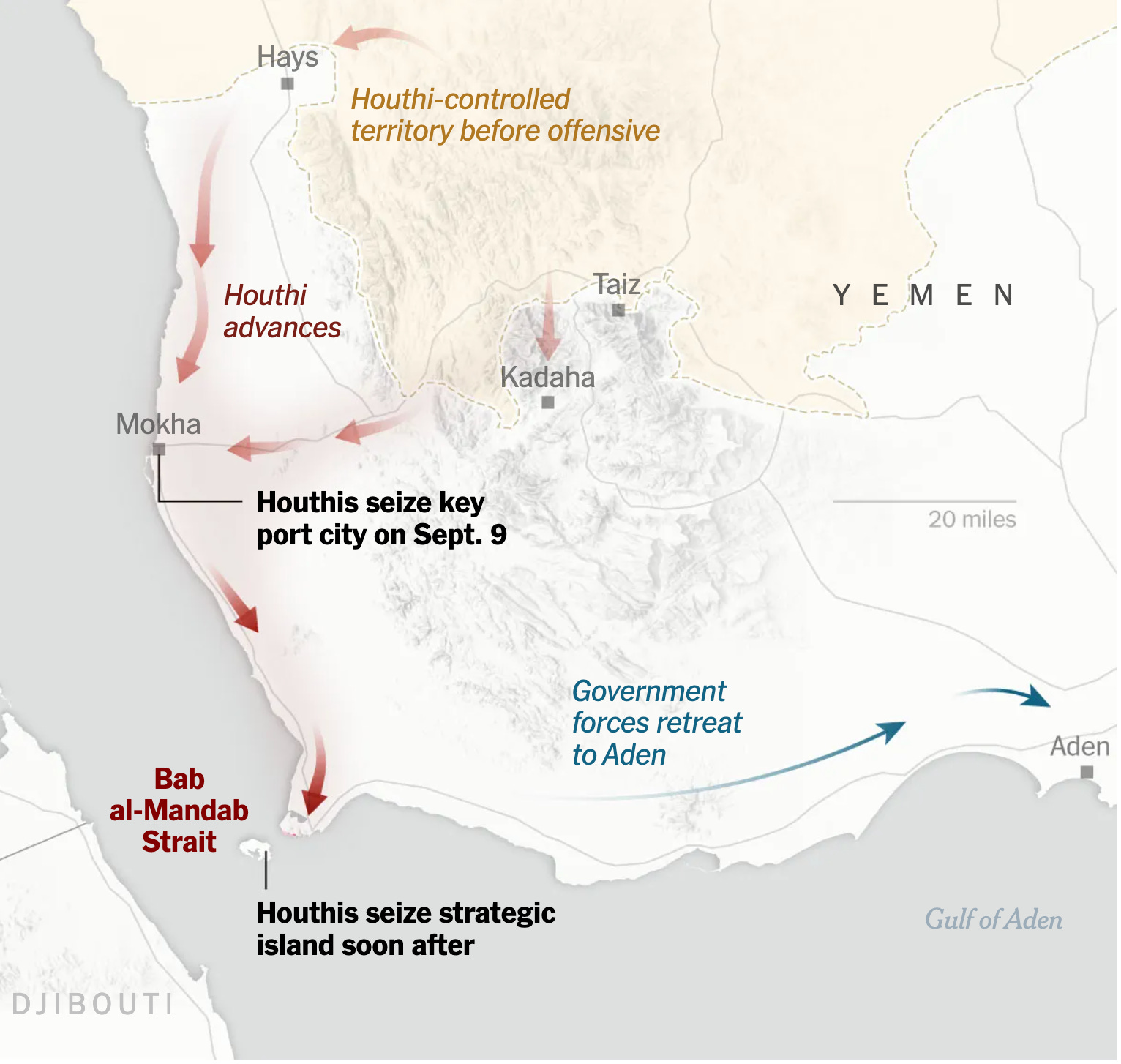
Meanwhile NYT readers were caught up to the events of September 10 with an explainer titled “How the Houthis Triumphed on the Red Sea and Sparked a New War in Yemen.” Note the work done by the second phrase of the headline which commits the whole article to backwardization about the cause of the current conflict — which the Saudis reignited by bombing Sanaa International Airport following the funeral of the Iranian Supreme Leader in July.
As is their way, however, the NYT gets some scoop:
It was obvious to the commander, Lt. General Tareq Saleh, that the Houthis wanted to seize his territory in order to reach the Bab al-Mandab Strait, one of the most important waterways in the world.
According to three Yemeni officials, he tried to warn his powerful allies in Saudi Arabia and the United States. About 10 percent of global trade goes through the strait. Amid the U.S.-Israeli war with Iran, both countries had an interest in preventing an Iran-linked militia from winning a perch beside it.
Yet last month — when the Houthis did just that — no one was able, or willing, to stop them.
…
“The Yemeni government is basically a fiction at this point,” said Gregory Johnsen, a nonresident fellow at the Arab Gulf States Institute in Washington. “They spend more time fighting one another than they do the Houthis.”One of the key players in this government was General Saleh. The nephew of Yemen’s former authoritarian leader, he had made plentiful enemies over the years as he seesawed from one alliance to another— siding with the Houthis, then joining the government.
In Mokha, with Emirati backing, he formed his own armed faction. His soldiers, who numbered around 50,000, served as a bulwark against the Houthis pushing south toward the Bab al-Mandab. Then, in January, the Emirates withdrew from Yemen amid a feud with Saudi Arabia. Saudi officials consolidated their control over the government’s many factions. Once again, General Saleh found himself with a new sponsor: Saudi Arabia.
And has informative infographics: