Yves has been keeping me busy this weekend.
IRGC and Ansar Allah Fire Away At Tankers, Oil Facilities, Airports
Oct 10: The Iranian Revolutionary Guard Corps (IRGC) hit at least one more tanker in the Strait on Friday, making last week’s narrative wars a distant memory.
Ansar Allah, for their part, hit more Saudi oil facilities, but Thursday’s airport attacks resulted in many airlines cancelling all flights to Saudi Arabia.
In Yemen, Saudi-backed forces claim to have taken Bab al-Mandeb and even Mocha, and Ansar Allah has issued denials of those claims, some quite convincing. Saudi bombing campaign continues in Yemen, to differing results based on who is describing them.
Putin also got involved, meeting with the Iranian President and cutting a diesel deal with Trump.
Iran Tightens the Vise
The IRGC claimed a hit on a giant LPG (Liquefied Petroleum Gas) carrier that had been using the “unauthorized route” south of the Strait of Hormuz. They claimed it had a large fire in the engine room, per Tasnim. Al Jazeera confirmed the report, saying it was a “massive fire.”
The IRGC holds the US military responsible and says Washington is “deceiving shipping and insurance companies and paying large bribes.” It says companies that cooperate with the US will be sanctioned.
They also say enforcement will “no longer be confined to the Strait of Hormuz. Any vessel using an unauthorized passage (will) be pursued throughout the region, and punishment would be certain.”
Read the rest at Naked Capitalism.
Saudi Airports and Oil Facilities Blasted Again and Again
Oct 11: Yemen’s Ansar Allah pounded Saudi Arabia Saturday, injuring hundreds at the Riyadh airport but also halting flights at King Fahd airport in Dammam while rumors of hits on Saudi oil facilities ran rampant.
The attacks drew American condemnation and inspired POTUS Trump to muse that the US “may” join ongoing Saudi strikes on Yemen.
Meanwhile, a supertanker on the southern or “unauthorized” route through the Strait of Hormuz hit a mine, and 22 crew members had to be rescued by the UAE National Guard (although it might have been a separate incident, as neither report named a ship).
And oil prices moved up despite Trump’s deal with Putin for diesel fuel, due to Hurricane Isaias in the Gulf of Mexico.
Saudi Airports and Oil Facilities Hit Harder Than Ever
Saudi Arabia’s General Authority of Civil Aviation (GACA) issued a statement early Sunday saying at least 12 were killed and 309 injured at King Khalid International Airport. The dead are four Saudis, two Bangladeshis, and one each from the US, Egypt, Jordan, Syria, Palestine and Sudan. Operations at the airport were temporarily suspended.

Riyadh wasn’t the only Saudi airport hit. A projectile landed near King Fahd International Airport in Dammam, per AFP via CBS (Yemeni media claims Saudi media reported a direct missile hit, but I could not confirm that), stopping flights for an undetermined amount of time.
The Saudis did claim a ballistic missile was shot down over Al-Kharj governorate and a drone shot down over the Eastern Province.
Ansar Allah also claimed to have attacked the Ghawar field in the Eastern Province of Saudi Arabia with a ballistic missile. Ghawar is the world’s largest oil field. Kayhan reports that missiles and drones hit the Ghawar field in the Eastern Province at the same time as the airport strike. It says video from regional media shows smoke.
Read the rest at Naked Capitalism.
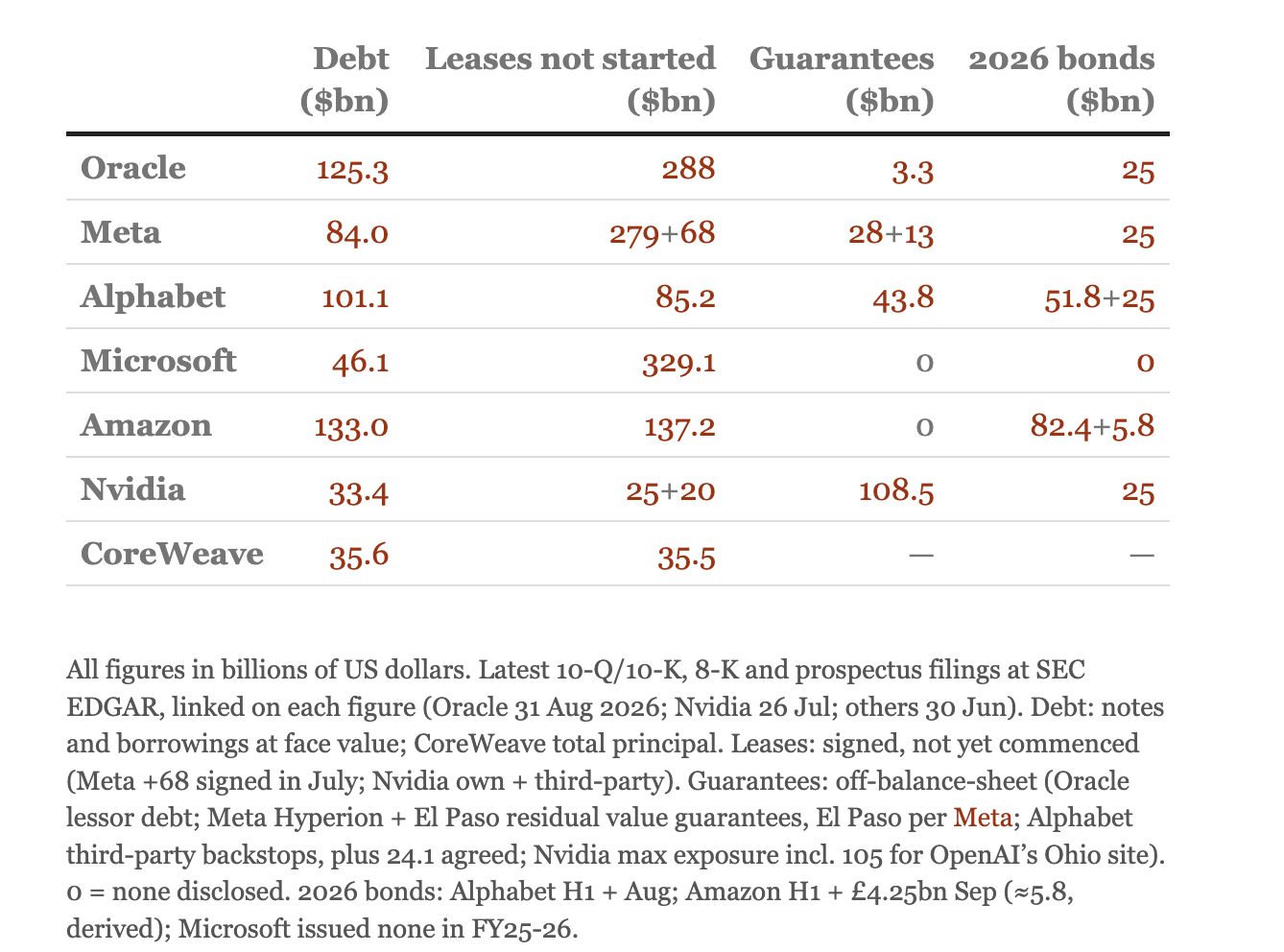
Banks Struggle to Digest the Mounting Debt Driving the AI Boom
Oct 12: Silicon Valley is down with POTUS Trump’s rebranding of “artificial intelligence” as “super intelligence” but that hasn’t freed the “super intelligence” companies of their need for massive capital infusions.
SI, Yes AI, No
First the rebranding via The Verge:
When President Donald Trump announced his plans to rebrand artificial intelligence as “super intelligence,” you’d be forgiven for being skeptical that it would catch on. While most of the broader population is sticking with AI, some of Silicon Valley’s most powerful are falling in line and trying to give Trump the great AI rebrand he so desires.
That Elon Musk was quick to jump on board, promising to rename SpaceXAI to SpaceXSI, isn’t surprising. When, hours after Donald Trump declared that “The White House considers anyone that uses the term, ‘Artificial Intelligence,’ as opposed to the highly accepted new and more accurate term, ‘Super Intelligence,’ THE ENEMY!” Marc Benioff announced that Salesforce would rename AIForce to SIForce; it seemed like a quick capitulation, but not entirely out of character.
Nvidia CEO Jensen Huang attended the summit where the executive order requiring government agencies to use the term “super intelligence” was announced. He’s also aligned himself with Trump, saying he believes the danger posed by AI is overblown. So it was somewhat predictable that when Nvidia declared that it would “commit” $1 billion to scientific advancement, that included “super intelligence research.” Of course, Huang has a lot to lose if he gets on Trump’s bad side.
The latest to cave is Microsoft’s Satya Nadella, who attended the same AI summit as Huang along with Mark Zuckerberg, Sundar Pichai, Jeff Bezos, Dario Amodei, and Musk. In a post calling for building an “emergency brake” for AI yesterday, Nadella repeatedly referred to the technology as “super intelligence.”
As much as you’d think this name change would be revolutionary, it doesn’t appear to have impacted balance sheets.
Capital Is the Tech Bottleneck
Tech titans gathered at the DBS Asia Future Forward Conference in Singapore on Monday and the consensus was clear: capital not hardware is the biggest bottleneck facing the industry.
Broadcom CEO Hock Tan said financing could become a bigger obstacle to AI expansion than shortages of semiconductors, memory chips or electricity, as the industry races to build the infrastructure needed to power increasingly sophisticated models.
″[What] I think might be the biggest constraint is capital,” Hock Tan said at the DBS Asia Future Forward Conference in Singapore on Monday.
Intel CEO Lip-Bu Tan echoed concerns about financing, pointing to the rising cost of capital and questions over whether companies investing heavily in AI will eventually generate sufficient returns.
“If there’s any challenge in the front, it’s capital and the cost of capital, and then the other part is in the longer run, people want to see the ROI,” he said.
Their remarks highlight an emerging challenge for the AI industry, which has poured enormous sums into data centers, advanced chips and power infrastructure in anticipation of surging demand for computing capacity.
The warnings come as rising borrowing costs threaten to complicate financing for technology companies investing heavily in AI infrastructure. Higher bond yields could make it more expensive to fund data center construction and chip purchases, potentially putting pressure on the economics of projects that may take years to generate returns.
How much debt are we talking about? This much debt: